Case study
HNK Solicitors
How seven years of SEO groundwork made a Liverpool law firm a source AI assistants cite.
- Client
- HNK Solicitors
- Sector
- Legal — civil litigation
- Location
- Liverpool, acting nationally across England and Wales
- Engagement
- 7+ years, ongoing
- Primary services
- GEO, AEO and AI search optimisation · SEO and content marketing
- Also delivered
- Branding and design · Website UX, build and maintenance · Google Ads and Meta Ads · Social media

Answer-first summary
HNK Solicitors are cited across AI search platforms on questions about police claims, data breaches and criminal injuries compensation, and the visitors those citations send convert at a key-event rate of 12.57% against 2.07% for organic search overall. Castle did not achieve that by bolting an AI search project onto the account. We achieved it because seven years of SEO work had already built the things AI systems retrieve: crawlable architecture, deep topical coverage of a defined subject, established rankings and demonstrable legal expertise published under one brand.
The firm came to Castle over seven years ago spending roughly £30,000 a month on Google Ads with almost no other route to new enquiries. We rebranded the firm, rebuilt the website around conversion, ran paid campaigns to keep leads coming in, and built an SEO content programme that made organic search the dominant acquisition channel. It now accounts for 78.44% of all site traffic and around 270 leads a month. HNK stopped paid advertising altogether, and in 2025 the firm was acquired by Express Solicitors, with its specialist profile and organically generated caseload central to its appeal.
This case study is about what happened next, and about why the firms that will win in AI search are largely the firms that did the unglamorous work first.
The argument
Why this is a GEO case study.
Most AI search case studies describe a project. A site allows the crawlers through, adds some schema, restructures a few pages into question-and-answer format, and reports a handful of citations. The problem with that as evidence is that the same steps produce very different outcomes on different sites, and nobody publishes the ones where nothing happened.
What makes HNK worth writing up is that the work is separable. Castle spent seven years building an organic content programme in a narrow field, then extended it into AI search. We can therefore be reasonably specific about which part did what. The AI search work removed obstacles, clarified meaning and restructured content so that it could be extracted. It did not create the authority. That already existed, and it existed because of a long, ordinary content programme that had nothing to do with AI when it started.
That is the honest version of the discipline. Almost everything that makes a site retrievable by an AI system is something a good SEO programme already builds: crawlable architecture, clean internal linking, comprehensive topical coverage, established rankings, real subject-matter expertise and brand authority in a defined field. What has changed is what you do with those foundations, and how you measure whether it worked.
The rest of this case study sets out both parts, in that order: what AI search is currently returning for HNK, and the seven years of work that made it possible.
Traction
What AI search is currently returning.
AI search is early, volumes are small and attribution is imperfect. We would rather present these figures as evidence of traction than as a mature channel.
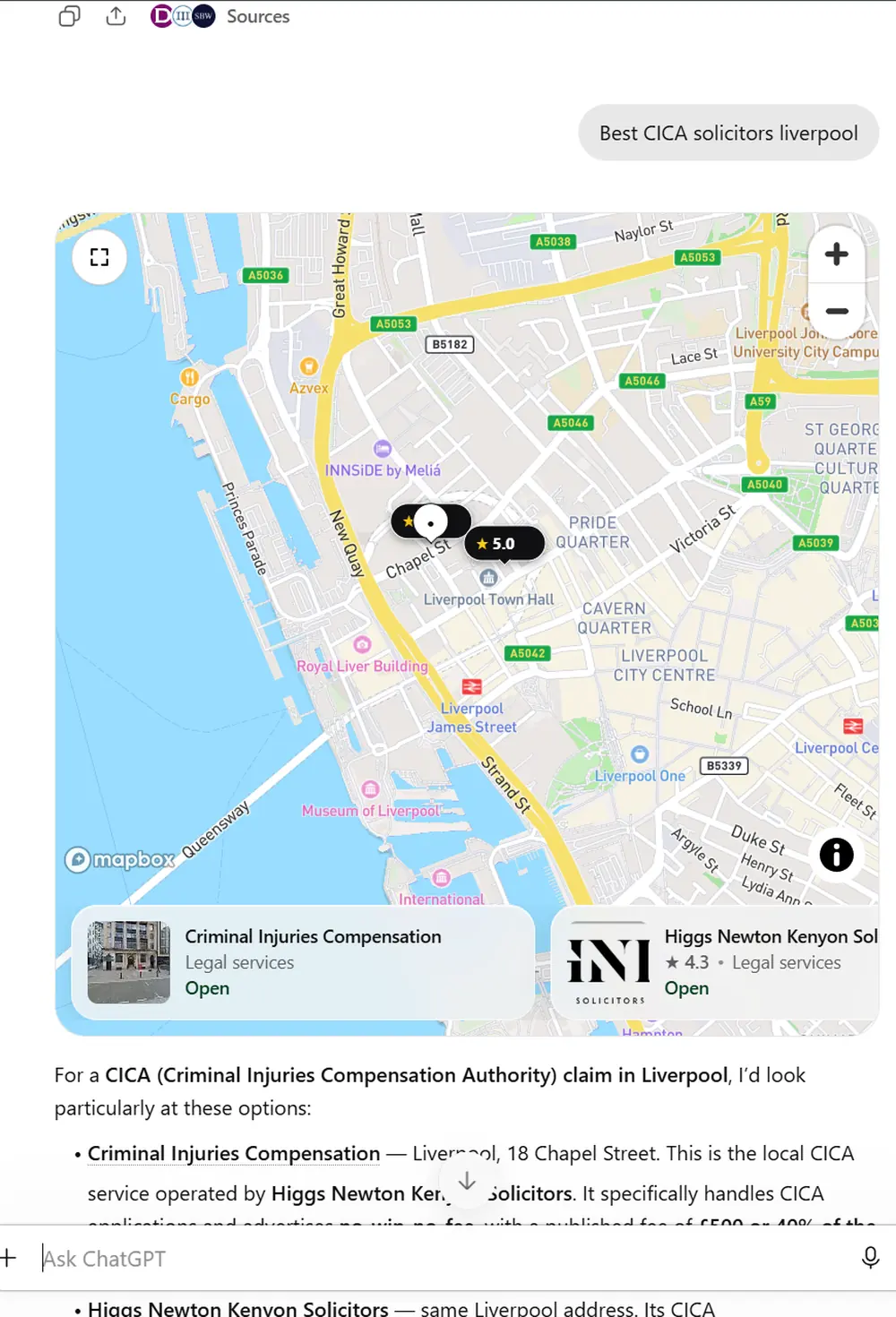
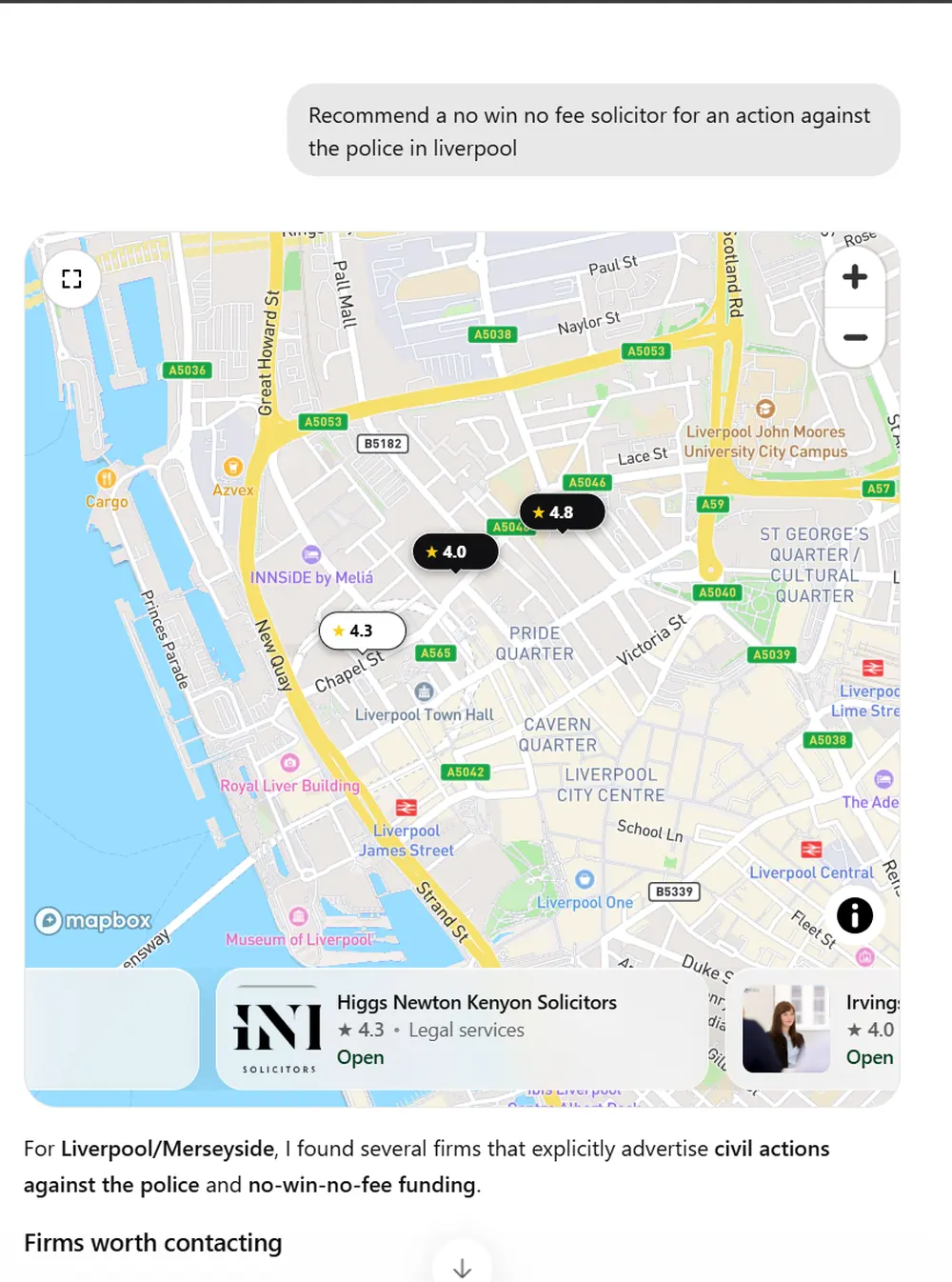
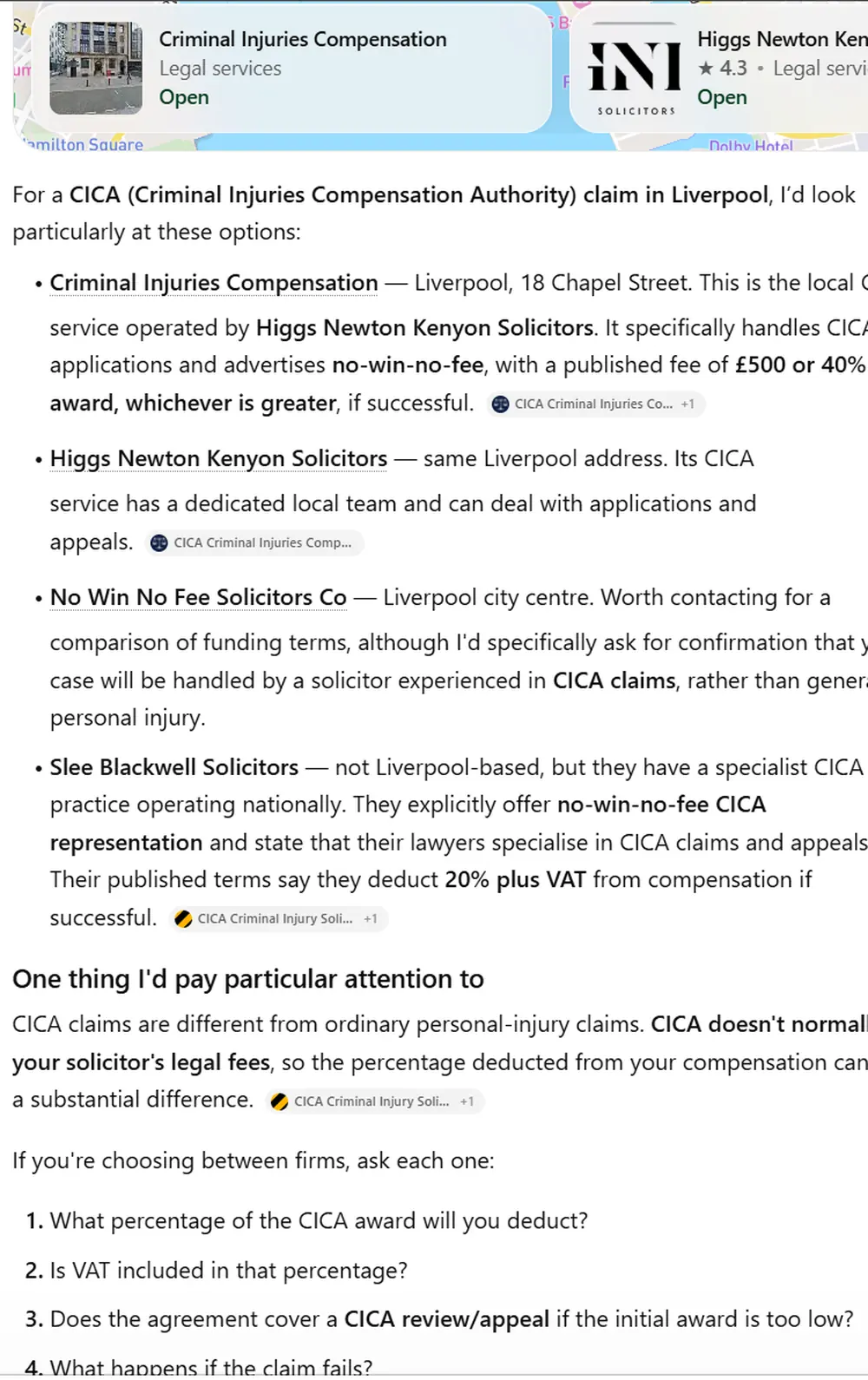
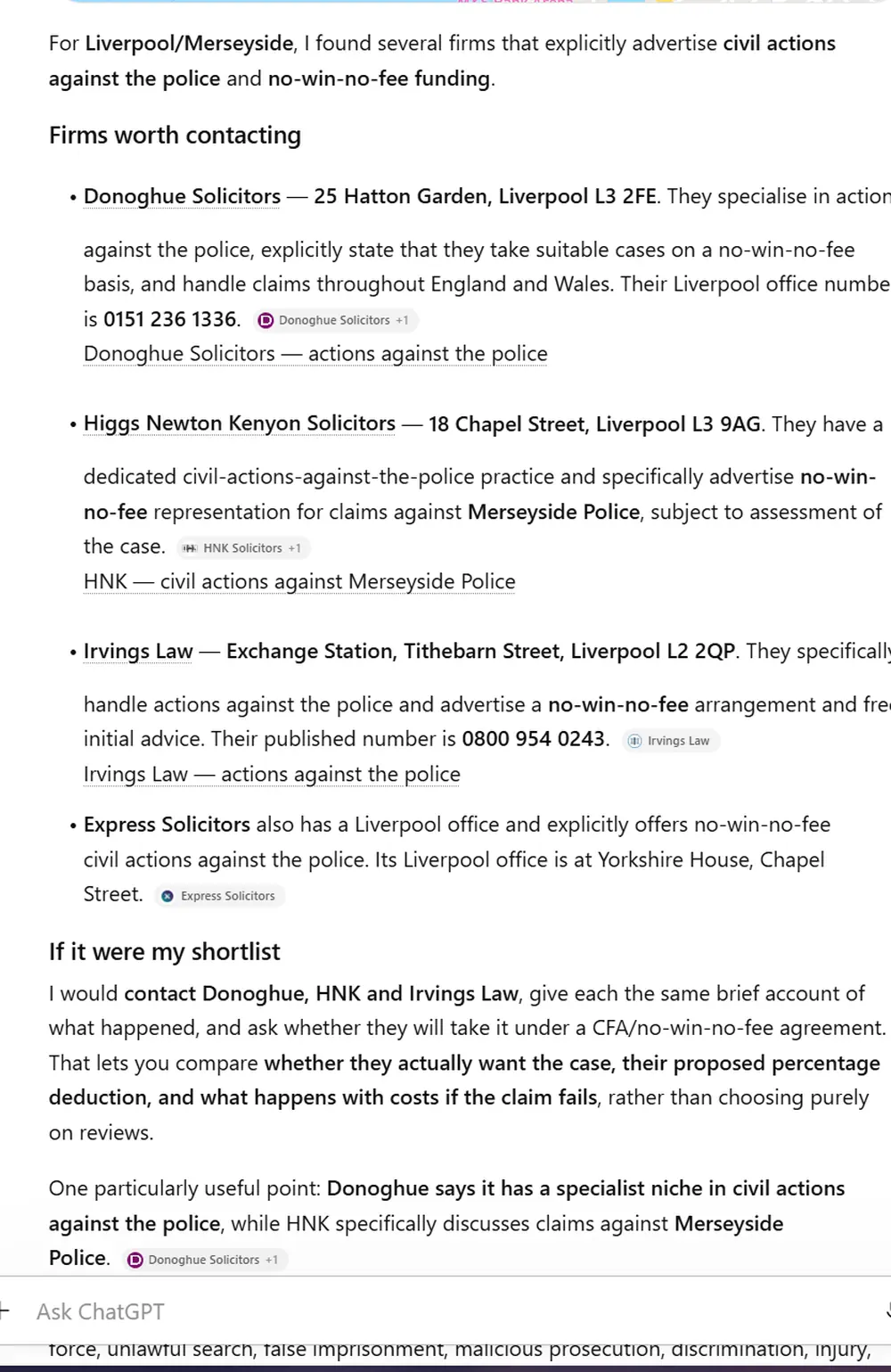
As of August 2026, Ahrefs data shows HNK cited across AI search platforms 163 times, and the site appearing in 68 AI Overviews. Google Analytics attributes roughly 167 sessions a month to AI assistants, with an average engagement time of 1 minute 15 seconds.
When Castle began tracking AI citations for HNK in January 2026, the site was cited in 38 responses. It has since risen to 163 as of August 2026.
The conversion gap
That gap deserves a careful reading. The volumes behind the AI figure are much smaller, so the percentage is more volatile than the organic one, and attribution for AI-referred traffic is still developing across the industry. What the number appears to reflect is intent. Someone who has already described their situation to an assistant, been given an explanation and then been pointed towards a firm is a long way further down the journey than someone opening a search result. They arrive informed and closer to instructing.
If that pattern holds as volumes grow, a comparatively small amount of AI-referred traffic could account for a disproportionate share of enquiries.
The client
About HNK Solicitors.
HNK Solicitors is a specialist civil litigation firm with a multi-disciplinary team of lawyers acting for claimants in data breach and group action claims, actions against the police, and criminal injuries compensation. The firm is based in Liverpool but takes instructions across England and Wales, and has brought claims against police forces throughout both jurisdictions.
HNK Solicitors was acquired by Express Solicitors in April 2025, while continuing to work from its Liverpool office, with both partners staying on working for Express despite resigning as directors.
Civil actions against the police are among the firm’s most valuable areas of work. They also happen to be among the least understood by the public. Many people who have grounds for a claim have no idea that what happened to them was unlawful, let alone that they might be entitled to compensation. That gap between eligibility and awareness became the foundation of the entire organic strategy, and, as it turned out, of the AI search strategy that followed.
The brief
Replace the channel the firm was renting.
HNK Solicitors first approached Castle for a rebrand and a new website capable of generating enquiries rather than simply describing the firm. Alongside that, they wanted us to take on paid acquisition through Google Ads and to open up Meta as a second channel for lead generation.
The commercial problem sat underneath all of it. The firm was spending in the region of £30,000 a month on Google Ads and was almost entirely dependent on that spend for new instructions. Every lead had a price attached, and if the budget stopped, so did the pipeline. Growth meant either accepting rising costs per acquisition in an expensive legal vertical or building something the firm actually owned.
They chose the second option, but sensibly did not want to switch off the first while waiting for it. The brief was to keep paid acquisition performing in the short term while we built an organic channel capable of eventually replacing it.
Nobody was thinking about AI search in year one. AI search or AI SEO wasn’t something people knew of in 2019 and didn’t exist in any form that mattered. What follows is worth reading with that in mind, because the foundations that now make HNK retrievable were laid for entirely different reasons.
The foundations
Seven years, in order.
- 2019Rebrand and rebuildHiggs, Newton, Kenyon becomes HNK Solicitors. New logo, new site built around conversion, enquiry routes throughout rather than one contact page.
- 2019Technical foundationsArchitecture, URL structure, sitemap, robots.txt, Core Web Vitals, SSL, LegalService and LocalBusiness schema. The same robots.txt revisited in 2025.
- 2019–20Paid media holds the lineGoogle Ads kept running while Meta is opened. Editorial-styled creative wins: 600+ leads in the first full month at under £3 each.
- 2020–23The organic engine compoundsLong-tail articles on police powers, arrest and detention, clustered into pillars. Organic traffic up 188%, 209%, 330%, 90% year on year.
- 2024The ads go offOrganic outperforms both paid channels combined. £30,000 a month of media spend stops entirely; enquiries rise.
- 2025AcquiredExpress Solicitors acquires HNK, with the specialist profile and an owned acquisition channel central to the deal.
- 2026Extended into AI searchCrawler access, schema, answer-first restructuring and passage-level rewriting. Citations go from 38 in January to 163 by August.
Brand and website
Before any of it could work, the firm needed a brand that looked like the specialist practice it was. The firm had traded largely as “Higgs, Newton, Kenyon Solicitors”, which was accurate but cumbersome, difficult to recall and awkward in a search result or an ad headline. Castle shortened it to HNK Solicitors and built a new logo around the initials: cleaner, more contemporary, and far easier to recognise across a website, a Facebook ad and a letterhead alike.
That decision has aged unexpectedly well. A short, distinctive, consistently used name is easier for a search engine to associate with a subject, and easier for an AI system to resolve as an entity, than a three-surname partnership title that gets abbreviated differently in every directory listing.
With the brand signed off, we designed and built a new website with conversion as the organising principle. The site was faster, simpler to navigate and properly optimised for mobile, desktop and tablet, which matters more in this sector than most: someone searching about an arrest or a data breach is very often doing it on a phone. Rather than funnelling every visitor to a single contact page, we placed enquiry forms and contact prompts throughout the site so that a visitor could act from wherever they happened to land. That decision paid off later, when the majority of traffic began arriving on articles rather than service pages.
The technical SEO groundwork
Our web team built the technical foundations at the same time, which is a large part of why the SEO programme was able to compound the way it did.
That work covered a clean, logical site architecture and URL structure, a submitted XML sitemap, a properly configured robots.txt that guided crawlers without accidentally blocking anything important, Core Web Vitals monitoring and optimisation, an SSL certificate, and LegalService and LocalBusiness schema.
None of it is glamorous. All of it is the reason the content we published years later was discoverable within days rather than months. The robots.txt file, incidentally, is the same one we revisited in 2025 to make sure AI crawlers could reach the site.
Paid media
Generating leads while the organic engine was built.
SEO takes time, but enquiries could not wait. Castle took over the existing Google Ads account and kept it working, then opened a channel the firm had never used: Meta. We ran four sharply different creative approaches concurrently and let performance decide. The variant styled as a news article outperformed the rest by a wide margin, which told us something useful about the audience and shaped everything that followed: people researching a possible claim respond to editorial framing, not to advertising framing.
That testing model became the template for the group action campaigns that followed, including data breach actions against Arnold Clark, EasyJet, Simplify Group and Capita. Paid social remained the fastest route to volume whenever a new action needed claimants in a hurry. What it could not do was reduce the firm’s cost of acquisition permanently. That required the longer piece of work running in parallel, and it is that work, rather than the ads, that HNK’s AI search position rests on today.
SEO
The organic engine.
Castle started with keyword and competitor research to map how people actually search when they are dealing with a legal problem, then deliberately went after the lower hanging fruit to start with. Head terms like “actions against the police solicitor” are contested by every firm in the sector and reach people who already know they have a claim. That is the smallest and most expensive part of the audience.
So we went further back in the journey. We identified long-tail queries with meaningful search volume and low competition, produced a detailed article for each, and connected them through an internal linking structure of pillar pages and supporting content. Individual articles earned rankings quickly. The clusters they formed built topical depth, and that depth is what eventually made the broader, harder commercial terms winnable.
Why actions against the police?
Castle concentrated the early strategy on civil actions against the police for three reasons. HNK has a department dedicated to it. The cases are among the firm’s highest-value work. And the subject is surrounded by questions that almost nobody was answering well.
The research question we set ourselves was not “what would someone searching for a police claims solicitor type into Google”. It was broader than that: what does somebody search in the days and weeks after something has happened to them, before they have any idea it might be actionable?
Those searches look nothing like commercial queries. They are questions about rights during a stop and search, about what the police are and are not allowed to do during an arrest, about detention time limits, about what happens when charges are dropped. We researched the grounds on which claims can arise and worked backwards to the language people use to describe those experiences when they do not yet have the legal vocabulary for them.
Then we answered those questions properly, with content thorough enough to be genuinely useful and clear enough to be read on a phone by someone who is anxious.
The approach works commercially because it reaches potential claimants at the point of confusion rather than the point of comparison. Someone who arrives via an article explaining necessity to arrest, understands that their treatment may have been unlawful, and finds a firm that has explained it clearly is a very different prospect from someone comparing three firms on a commercial landing page. It is also why placing enquiry routes throughout the site mattered so much.
It is also, though nobody planned it this way, close to a description of how people query AI assistants. Someone typing a paragraph describing what happened to them at a police station is asking the same question, in the same register, as the search queries this programme was built around six years earlier. The research was already pointed at the right audience.
We should be clear about the principle underneath the content, because it is often misrepresented. We do not write long articles because length ranks, and we do not chase time on page as a metric in its own right. We write to satisfy the query completely: answer the question that was asked, cover the questions that follow from it, demonstrate real legal expertise, and give the reader no reason to go back to the results page. Search engines are trying to identify the pages that do that. Depth and engagement are consequences of getting it right, not levers to pull.
What that produced
| Organic traffic | New users | Sessions | |
|---|---|---|---|
| Year one | +188.05% | +75.80% | +64.22% |
| Year two | +208.97% | +27.78% | +28.14% |
| Year three | +330.40% | +152.60% | +148.94% |
| Year four | +90.1% | +91.9% | +100.7% |
Organic search has been the site’s largest traffic source for six consecutive years, accounting for 78.44% of all traffic across that period. It also drives the majority of conversions. Since April 2024 the site has generated an average of around 270 leads a month.
The site currently ranks for over 1,000 keywords, 208 of them in positions one to three. Eighteen of the twenty highest-traffic pages are articles produced as part of this programme, including the single best-performing page on the site. Because each article was written to cover a topic rather than a keyword, individual pieces rank for numerous related queries, which is where a good deal of the compounding comes from.
Some of that content has outranked gov.uk. For a claimant-side law firm to sit above the government’s own guidance on questions about police powers is an unusual result, and a fair indication of how thoroughly the subject was covered.
The switch
Switching the ads off.
Organic search eventually generated more leads per month than Google Ads and Meta combined. At that point the paid spend was no longer buying incremental growth, so HNK stopped it. Both channels, entirely.
The strategic gain is larger than the cost saving. HNK now owns its primary acquisition channel. Enquiries do not stop when a budget is paused, a CPC rises or an account is restricted, and the content producing those enquiries continues to earn traffic years after it was published. Paid media remains available and we still use it when a new group action needs claimants at speed, but it is now a tactical tool rather than the foundation the business rests on.
What an owned acquisition channel is worth
In 2025, HNK Solicitors was acquired by Express Solicitors.
We would not claim credit for a corporate transaction. What is worth saying is what was actually on the table. Express acquired a Liverpool practice with a national profile in civil actions against the police and data breach group actions, a substantial live caseload, and a steady flow of new instructions that arrived without media spend behind them.
That last point is the one that carries commercial weight. A firm generating around 270 enquiries a month from advertising has an acquisition cost attached to every one of them, and a buyer inherits that cost. A firm generating the same volume from content it already owns has an asset instead: a library of articles that will keep earning traffic, established rankings across a specialist field, and a recognised position in practice areas that are difficult to enter from a standing start.
For anyone weighing up whether long-term SEO investment is worth the patience it requires, that is the clearest possible answer. Organic visibility is not a marketing line item. It is enterprise value, and at the point of sale it shows up on the right side of the ledger.
The GEO programme
Extending the foundations into AI search.
Search behaviour has changed materially over the last two years. A growing share of queries now resolve inside an AI Overview, a ChatGPT answer or a Perplexity response, and a proportion of those users never click a link at all. For an informational content strategy of the kind Castle built for HNK, that is both a genuine risk and an obvious opportunity.
The risk is straightforward: traffic that used to arrive from an article ranking first can now be absorbed by a generated summary. The opportunity is that the same summary has to be sourced from somewhere, and the sites it draws on are the ones with depth, clarity and demonstrable expertise on the subject. HNK has spent seven years becoming exactly that.
This is the part of the story we think prospective clients should pay most attention to. AI search optimisation is not a replacement for SEO and it is not a separate discipline bolted on the side. Almost everything that makes a site retrievable by an AI system is something we had already built here. What has changed is what we do with those foundations.
Technical discoverability
Castle revisited crawler access first. Robots.txt was reviewed and updated so that AI crawlers can reach the content, alongside the existing checks on indexation, canonicalisation, sitemap health, site architecture and internal linking that already formed part of the SEO programme.
Worth being precise here, because a lot of what is written about GEO is not: allowing a crawler through does not cause a citation. It removes a blocker. If the content is inaccessible it cannot be retrieved at all, so access is necessary. It is nowhere near sufficient, which is why the remainder of this section exists.
Structured data
The site runs LegalService, LocalBusiness and FAQ schema. Structured data helps search systems interpret what a page is about, what entity publishes it and how the information is organised, which supports accurate understanding of the site.
We would put that carefully. Schema is not a citation mechanism and no markup guarantees inclusion in a generated answer. It makes meaning explicit rather than inferred, and where a site’s information is unambiguous it is less likely to be misread. In a sector where a firm can be confused with a similarly named practice, that clarity has value on its own terms.
Topical authority and entity clarity
The content programme turns out to have been unusually good preparation for this.
Seven years of publishing on police misconduct, unlawful arrest, detention rights, data breach claims and criminal injuries compensation has produced deep, interlinked coverage of a defined set of subjects, published consistently under one brand and one set of named solicitors. Consistent terminology, clear relationships between service pages and supporting articles, and a coherent structure across hundreds of pages all contribute to a system being able to identify what HNK is authoritative about.
An AI system assembling an answer about police claims is looking for sources with substantive coverage of the topic. Breadth alone does not achieve that. Sustained depth in a narrow field does.
Expertise and provenance
Legal content affects consequential decisions, so the standard applied to it is higher than for most subjects. That has always been true for search, and it is now true for AI-generated answers, where the identity and credentials of the source carry weight.
Castle strengthened the visible expertise on key content: solicitor commentary and quotes from the lawyers who handle these cases, clear attribution of who stands behind the information, review dates and last-updated stamps, and a process for keeping legal information current as procedure and case law move.
The commercial logic is simple. Where a system is selecting between sources on a question with real consequences for the person asking it, content with identifiable professional authorship and clear provenance is in a stronger position than content without. There is no formula here and no guaranteed outcome, but the direction of travel is clear enough to act on.
Answer-first structure and retrievability
Castle restructured priority content so that the main question is answered early and directly, with a concise summary near the top, headings that match how people actually phrase the question, complex legal information broken into sections that can be understood without reading the whole page, and FAQ blocks covering the follow-up questions a reader will have next.
The balance matters. Content stripped back to short answers reads as thin and demonstrates nothing. The aim is a page that gives a clear answer in its first paragraph and then earns its authority in the eight paragraphs that follow, so that it works for someone skimming, someone reading in full, and a system extracting a specific fact.
One point that gets missed: retrieval works on passages, not pages. A system pulling a section out of a 2,000-word article gets that section and nothing else, so a paragraph that opens with “as set out above” or refers to “the firm” without naming it arrives without its context. We rewrote priority sections to stand on their own, which means naming the subject, restating the qualifier, and resisting the temptation to lean on what came three headings earlier.
Conversational and problem-led queries
The original keyword research was built around what somebody types before they know they have a claim. That turns out to map neatly onto how people query AI tools.
Conversational search is longer, more specific and more situational than keyword search. People describe circumstances rather than naming services, and they ask follow-up questions. Our research had already gone after problem-led, question-shaped, early-journey queries because that was where the eligible-but-unaware audience was. We have extended it to cover the phrasing and follow-up patterns typical of conversational interfaces, but the underlying strategy did not need reinventing.
Refreshing rather than only adding
Rather than publishing endlessly, Castle works systematically through the established high-performing pages: updating anything out of date, improving existing answers, adding solicitor insight that is not available elsewhere, filling in subtopics that were missed, tightening structure and strengthening attribution to authoritative sources.
For a site with this much accumulated authority, protecting the existing library is worth more than adding to it. A page that has ranked for four years and been cited across the web is an asset. Letting it go stale wastes it.
Measurement
How Castle measures AI search visibility.
We treat this as a measurement programme rather than a project. Monthly, for HNK, Castle tracks:
- Citations across AI search platforms, via Ahrefs
- AI Overview appearances
- Assistant-referred sessions and engagement time in Google Analytics
- Key-event and conversion behaviour from AI-referred traffic, compared against organic
- Manual testing of the questions the firm’s prospective clients are actually asking these tools
We adjust the content on the basis of what the data shows rather than what the industry currently assumes. Attribution for AI-referred traffic is imperfect across the whole industry at the moment, and anyone telling you otherwise is selling something. We report it with its limitations attached.
What’s next
Off-site authority is the remaining opportunity.
The work to date has been almost entirely on-site, and that is where the next stage of the strategy points.
AI platforms weigh third-party corroboration heavily when deciding which sources to trust on a subject. A firm can have the best content on police claims in the country, but if nothing outside its own domain confirms that, an assistant assembling an answer has only one voice to go on. The planned next phase is to build those external signals: digital PR and placements in the legal and consumer press, consistency across legal directories and review profiles, and a deliberate presence in the comparison articles and community discussions that AI tools draw on when someone asks which firms handle this kind of claim. Off-site authority is the largest remaining opportunity on the account, and it compounds the same way the content programme did.
Alongside that we are extending the refresh programme across the older content library, broadening topical coverage into related practice areas, and building out the measurement framework so that AI-referred enquiries can be attributed with the same confidence as organic ones.
Results.
Summary
The work compounds. That sequence is not a coincidence.
HNK’s position in AI search took years of consistent work rather than a single campaign. The same foundations now supporting their organic performance are what make them retrievable in AI search, and what turned a marketing channel into something a buyer was willing to pay for.
If you are looking to build organic visibility that reduces your dependence on paid acquisition, strengthen your performance in traditional search, or prepare your content and technical setup for AI-powered discovery, we would be glad to talk it through.