Marketing · 13 min read
B2B Demand Generation Services: What to Buy and How to Judge
What B2B demand generation services include, how they differ from lead generation, how to measure them and what to ask a UK agency before you sign a retainer.

On this page — 15 sections
- TL;DR
- Table of Contents
- What B2B demand generation services actually include
- Demand generation vs lead generation
- How a programme moves buyers towards a sales conversation
- How to measure demand generation
- Our perspective
- How we can help
- How to assess a B2B demand generation agency
- Compliance: what UK businesses must check
- What to budget and how to plan the first year
- Is your business ready?
- FAQ
- Sources
- Recommended
B2B demand generation services are the programmes an agency runs to build awareness and interest among the companies you want to sell to, then guide those buyers towards a sales conversation. They cover content, search, paid media, email, data and reporting. The aim is a pipeline of qualified accounts, not a list of form fills. This guide explains what the services include, how they differ from lead generation, what to measure and how to choose a UK agency without wasting a year’s budget.
Be visible where B2B buyers search. Castle combines SEO with AI-driven search optimisation to help businesses improve visibility and attract high-quality leads.
TL;DR
- Demand generation builds awareness and interest across the whole buying journey. Lead generation captures contact details at one moment. Most B2B companies need both, in the right order.
- A good programme combines search (including AI search), paid media, expertise-led content, email and clean data, all reported against sales outcomes.
- Measure pipeline and closed revenue. Delivery metrics such as clicks and reach are not enough on their own.
- Before signing, ask for UK case studies with baselines, agree who owns the data and CRM, and check how the agency handles consent under PECR.
- Outsourcing marketing does not outsource your legal responsibility.
Table of Contents
- What B2B demand generation services actually include
- Demand generation vs lead generation
- How a programme moves buyers towards a sales conversation
- How to measure demand generation
- Our perspective
- How we can help
- How to assess a B2B demand generation agency
- Compliance: what UK businesses must check
- What to budget and how to plan the first year
- Is your business ready?
- FAQ
- Sources
What B2B demand generation services actually include
Salesforce describes B2B demand generation as a holistic, data-driven strategy that creates brand awareness and interest across the customer lifecycle, rather than a single lead-capture campaign. That is a useful test for any proposal you receive. If it only describes a gated download and a follow-up sequence, it is lead generation under another name.
In practice, a full demand generation service is made up of several workstreams:
- Strategy and audience definition. Who your ideal customer profile is, which accounts and roles matter, what they search for and where they spend time.
- Search visibility. Traditional SEO, technical audits, and increasingly optimisation for AI answers in tools such as ChatGPT and Gemini, so buyers find you while researching.
- Paid media. Google Ads, Meta Ads and other platforms used to reach buyers who are not yet searching for a supplier.
- Content and digital PR. Expertise-led articles, service and location pages and earned coverage that show buyers you understand their problem.
- Email and outbound support. Nurturing known contacts and supporting sales, within the law.
- Data and analytics. Tracking, CRM integration and reporting that connect activity to enquiries and revenue.
Data quality sits underneath all of it. One industry blog makes the point that inaccurate data weakens targeting, email, account-based marketing and outbound alike. It is a perspective rather than a measured finding, but anyone who has cleaned a CRM will recognise it.
Demand generation vs lead generation
The two terms are often used interchangeably, which is why proposals can look similar and deliver very different results.
| Lead generation | Demand generation | |
|---|---|---|
| Main goal | Capture contact details | Create awareness and preference |
| Typical tactics | Form fills, gated PDFs, webinar sign-ups | Search content, thought leadership, paid social, PR, email nurture |
| Audience | People already showing interest | Everyone who could buy, including those not yet in market |
| Timescale | Short | Medium to long |
| Main risk | Many contacts, few real opportunities | Slow to prove without good measurement |
The distinction as one source frames it: lead generation collects details through forms, gated content and sign-ups, while demand generation educates target accounts and stays in their minds until they are ready to buy.
The practical point is that the two work as a sequence. Demand creation makes people familiar with you. Lead capture then converts the ones who raise their hand. A business that only does the second ends up fishing in a shrinking pool and paying more for each enquiry.
How a programme moves buyers towards a sales conversation
B2B purchases rarely come from one touchpoint. A decision involves several people, a long evaluation and a lot of quiet research. A well-built programme works through stages, each with a job to do.
Stage 1: Be findable while buyers research
Buyers start with a problem, not a supplier. They search, ask AI assistants and read comparisons. Your content needs to answer those early questions clearly and credibly, in the formats search engines and AI tools can quote. Our guide to AI search optimisation explains how that visibility is earned.
Stage 2: Stay visible to people who are not ready
Most of your market is not buying this quarter. Paid social, retargeting, newsletters and useful content keep your name familiar so you are on the shortlist when a need appears. This is the part lead generation skips, and it is the core of demand generation.
Stage 3: Turn interest into a conversation
When someone engages repeatedly, the programme should offer a low-friction next step: a consultation, an audit, a pricing discussion or a tailored demo. The offer should match the buyer’s stage. Asking for a meeting after one blog visit usually fails.
Stage 4: Hand over to sales with context
Sales needs to know which pages the contact read, which campaigns they came from and which accounts they belong to. Agree a shared definition of a qualified opportunity before launch. Otherwise marketing reports success while sales sees poor leads.
Stage 5: Feed results back
Closed deals, lost deals and sales feedback should flow back into targeting and content. This loop is what separates a programme that improves over time from one that repeats the same activity each month.
How to measure demand generation
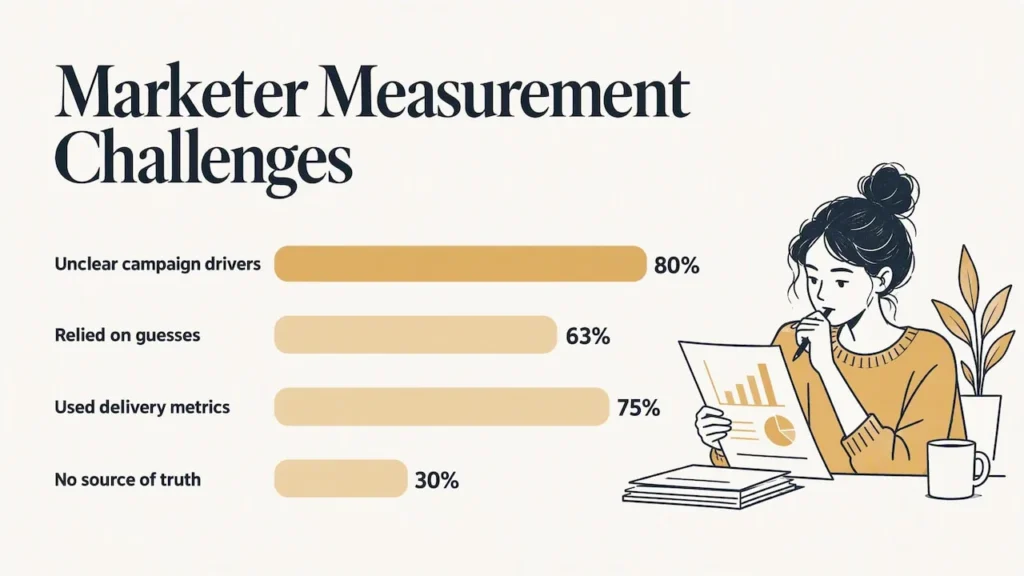
Measurement is where many programmes quietly fail. Marketing Week reported in 2026 that 80% of marketers did not fully understand what drove campaign success or failure, 63% relied on educated guesses, and 75% fell back on delivery metrics such as reach or click-through rate when performance was hard to explain. The same report found that 30% named having plenty of data but no source of truth as their biggest measurement challenge.
Timing matters too. Marketing Week’s analysis of long and short-term B2B marketing found that half of surveyed B2B marketers measured campaigns for less time than their business’s average sales cycle, and only 24% ran campaigns for longer than six months. When measurement is that short, teams tend to retreat to marketing qualified leads. The same source treats profitability, customer retention and closed revenue as the true performance measures.
A sensible reporting stack for B2B looks like this:
- Leading indicators: impressions in target accounts, branded search growth, share of voice in AI answers, engagement with key content.
- Mid-funnel: qualified enquiries, meetings booked, opportunities created, and the source of each.
- Outcomes: pipeline value, closed revenue, sales cycle length and customer retention.
Review leading indicators monthly, but judge the programme against your sales cycle. If deals take six months to close, a ninety-day report cannot show the full return. Our guide to the SEO metrics that matter covers the search side of this in more detail, and our piece on data-led decision making shows how to connect reporting to ROI.
Our perspective
We have run search and paid media since 2014, and we see the same pattern in B2B accounts. Companies buy leads, get a spreadsheet of names, then wonder why sales stops returning calls. The problem is rarely volume. It is that nobody built the awareness that makes a first conversation easy.
We think demand generation works best when search, AI visibility, paid media and content are planned together by one team. That is how we deliver our services: one in-house team, with reporting tied to real enquiries and revenue rather than vanity metrics. When the person optimising your search pages talks daily to the person running your ads, messages stay consistent and budget does not leak between channels.
We also believe AI search is now part of the buying journey. Buyers ask ChatGPT and Gemini to shortlist suppliers before they ever visit a website. Being cited in those answers, through Generative Engine Optimisation and Answer Engine Optimisation, sits alongside traditional SEO rather than replacing it. Early movers have an advantage because the sources AI tools trust tend to be built over time.
How we can help
If you want search visibility, paid media and AI search optimisation working to the same pipeline target, our services cover SEO, GEO, AEO, Google Ads, Meta Ads, lead generation and analytics under one roof. We scope each engagement around your sales cycle, your target accounts and the outcomes your sales team actually counts.
If you are still comparing options, our guide to choosing a digital marketing agency in the UK sets out what to check, and full-service versus single-channel agencies explains why joined-up delivery usually performs better.
How to assess a B2B demand generation agency
The agency you hire will shape your pipeline for at least a year, so treat selection like a procurement decision. One UK guide to questions for a demand generation agency suggests the following checks, which match what we would want in your position.
Evidence
- Comparable UK case studies, with the baseline before work began.
- Pipeline figures before and after twelve months, not only traffic or lead counts.
- A breakdown of which channels contributed.
- A clear explanation of how the agency qualifies leads, ideally using your sales team’s definition.
- What the agency would change in your current approach, and why.
Commercials and control
- Who owns the data, accounts, CRM records and content at the end of the contract.
- What reporting you receive, how often and in what format.
- Contract length, notice period and exit terms.
- Whether one team delivers the work or it is split between subcontractors.
Fit
Location and working style matter more than many buyers expect. We cover this in why agency location still matters and in our checklist for finding a trustworthy full-service agency.
Red flags
- Guaranteed lead numbers with no mention of quality.
- Reports that stop at clicks, impressions or cost per lead.
- Purchased contact lists presented as a strategy.
- Reluctance to share how data was obtained.
Compliance: what UK businesses must check
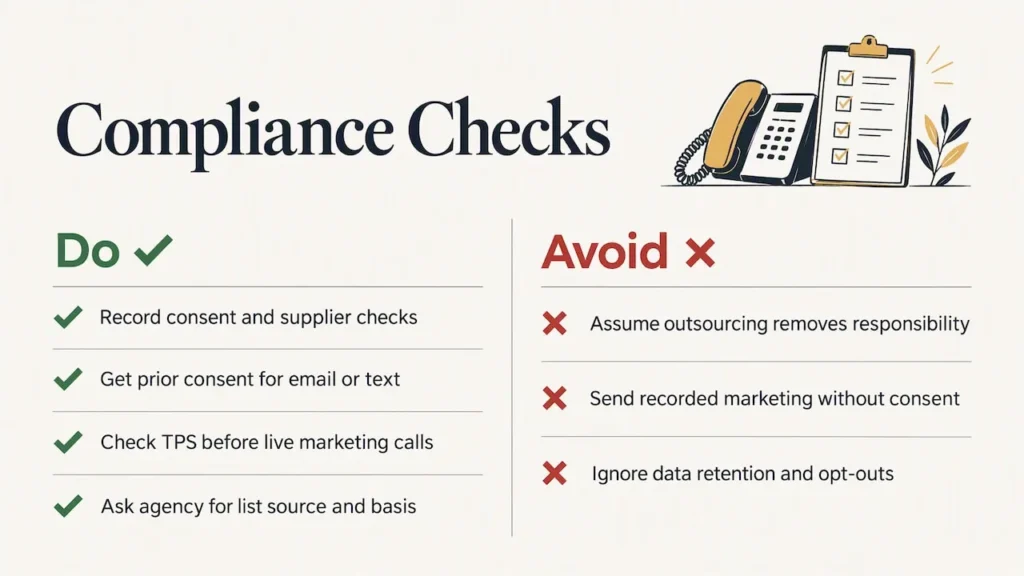
This is the part many buyers skip, and it is where the risk sits with you. UK government guidance states that outsourcing direct marketing does not remove your responsibility: consent, supplier due diligence and records must be demonstrable. The same bulletin says prior consent is needed for marketing by email or text, subject to the soft opt-in conditions in the Privacy and Electronic Communications Regulations (PECR), and that you should keep records of how and when consent was obtained.
For phone outreach, government guidance explains that PECR restricts unsolicited live marketing calls to numbers registered with the Telephone Preference Service unless the person has said they do not object. Recorded marketing messages need prior consent.
B2B is not a free-for-all. The Information Commissioner’s Office publishes specific guidance on business-to-business marketing, because the rules differ depending on who you are contacting. Read it before approving any outbound or email programme, and ask your agency to state where each contact list came from, what lawful basis applies, how long data is kept and how opt-outs are honoured. If you want a quick internal check, our GDPR marketing checklist is a good place to start. For a specific list or campaign, take advice from a data protection specialist or solicitor.
What to budget and how to plan the first year
Demand generation is normally bought as a monthly retainer, with project fees for builds such as new service pages or a redesigned site. We do not publish fixed prices because the right scope depends on your market, sales cycle and starting position. We scope each engagement individually after learning how you sell.
A realistic first year tends to follow this shape:
- Months 1 to 2: audit, tracking set-up, CRM integration, audience definition and agreement on what counts as a qualified opportunity.
- Months 3 to 5: content and technical fixes go live, paid campaigns launch and early leading indicators appear.
- Months 6 to 9: enquiry quality improves as search visibility and brand familiarity build. Optimise using sales feedback.
- Months 10 to 12: review pipeline and closed revenue against the baseline, then decide where to scale.
If your sales cycle is longer than six months, expect the full revenue picture to arrive later than this timeline. That is why the measurement point above matters so much.
Is your business ready?
Demand generation pays off fastest when a few things are already true:
- You know who your best customers are and why they buy.
- Your website explains your offer clearly and converts visitors.
- Sales and marketing agree on what a good lead looks like.
- You can wait several months for compounding results.
If your website is weak, start there. Our guide to getting your website to the top of Google and our view of what still works in SEO in 2026 will help you judge your foundations.
FAQ
What is the difference between a demand generation agency and a lead generation agency?
A lead generation agency focuses on capturing contact details from people who show interest, usually through forms, gated content or outbound outreach. A demand generation agency also builds awareness and preference among buyers who are not yet in market. Many B2B businesses need both, and the best results come when they are planned together.
How long does B2B demand generation take to work?
Early signals such as search visibility and engagement can appear within a few months, but pipeline results usually follow your sales cycle. Marketing Week’s research suggests many B2B teams measure for less time than their sales cycle, which makes good campaigns look weaker than they are. Agree your measurement window before you start.
Which metrics should I ask a demand generation agency to report?
Ask for qualified enquiries, meetings booked, opportunities created, pipeline value and closed revenue, with the source of each. Delivery metrics such as clicks and impressions are useful for diagnosis but should not be the headline. Insist that reports connect to your CRM so sales can verify them.
Is B2B email and phone marketing allowed in the UK?
Yes, within the rules. PECR requires consent for most electronic marketing, restricts unsolicited marketing calls to numbers on the Telephone Preference Service, and applies differently depending on who you contact. Check the ICO’s business-to-business guidance and ask your agency to document consent and data sources.
Can a full-service agency do demand generation?
Yes, and often well, because search, paid media, content and analytics need to work together. A single team avoids mixed messages and gaps between channels. Check that the agency reports on pipeline and revenue, not only on its own channel.
Sources
- Salesforce: What Is B2B Demand Generation?
- Tomba: B2B demand generation agency
- Marketing Week: Measurement gaps, Generation Alpha, B2B content
- Marketing Week: The long and short of B2B marketing
- B2B Pipeline: Questions for a demand generation agency
- UK government: Special Bulletin on Direct Marketing
- UK government: Direct marketing callers and PECR
- ICO: Business-to-business marketing