Marketing · 12 min read
AI Lead Generation: How UK Businesses Can Use It Well
AI lead generation explained for UK businesses: what it does, where it helps, a step-by-step workflow, UK GDPR and PECR rules, and how to measure results.

On this page — 15 sections
- TL;DR
- Table of Contents
- What AI lead generation actually is
- Where AI helps, and where it does not
- A practical workflow, step by step
- AI inside paid and search channels
- Can ChatGPT generate leads?
- UK rules you need to build in from day one
- Choosing AI lead generation tools
- Measuring whether it works
- Our perspective
- How Castle can help
- FAQ
- Sources
- Recommended
AI lead generation uses machine learning, language models and automation to find likely buyers, score them, personalise the first contact and pass the best ones to sales. Used well, it removes repetitive research and speeds up follow-up. Used carelessly, it fills your CRM with poor data and creates compliance risk under UK GDPR and PECR. This guide shows where AI genuinely helps, how to build a workable process, what the rules say and how to measure whether it is paying off.
Attract more qualified search leads. Castle combines SEO with AI-driven GEO and AEO to help businesses improve visibility in search and attract high-quality leads.
TL;DR
- AI is strongest at repetitive, checkable work: building prospect lists, enriching records, scoring leads and drafting first-touch messages.
- People should still own the audience, the offer, the review of outreach and the final sales conversation.
- In the UK, automation does not lighten your duties: lawful basis, transparency, objection rights and PECR all still apply.
- Measure against a baseline of at least one full sales cycle, and track AI-sourced and AI-influenced pipeline, not just lead volume.
- Fix your data and your ideal customer profile before you buy more tools.
Table of Contents
- What AI lead generation actually is
- Where AI helps, and where it does not
- A practical workflow, step by step
- AI inside paid and search channels
- Can ChatGPT generate leads?
- UK rules you need to build in from day one
- Choosing AI lead generation tools
- Measuring whether it works
- Our perspective
- How Castle can help
- FAQ
- Sources
What AI lead generation actually is
The term covers a set of tasks rather than one product. According to Zapier’s overview, AI lead generation uses machine learning, large language models and automation to find potential customers and start or develop conversations. In practice that means analysing company, contact and behavioural data, building or enriching prospect lists, scoring buying likelihood, drafting personalised outreach and supporting inbound enquiries through chatbots.
IBM describes the same stack as machine learning, natural-language processing and predictive analytics working together to identify and qualify prospects and personalise outreach.
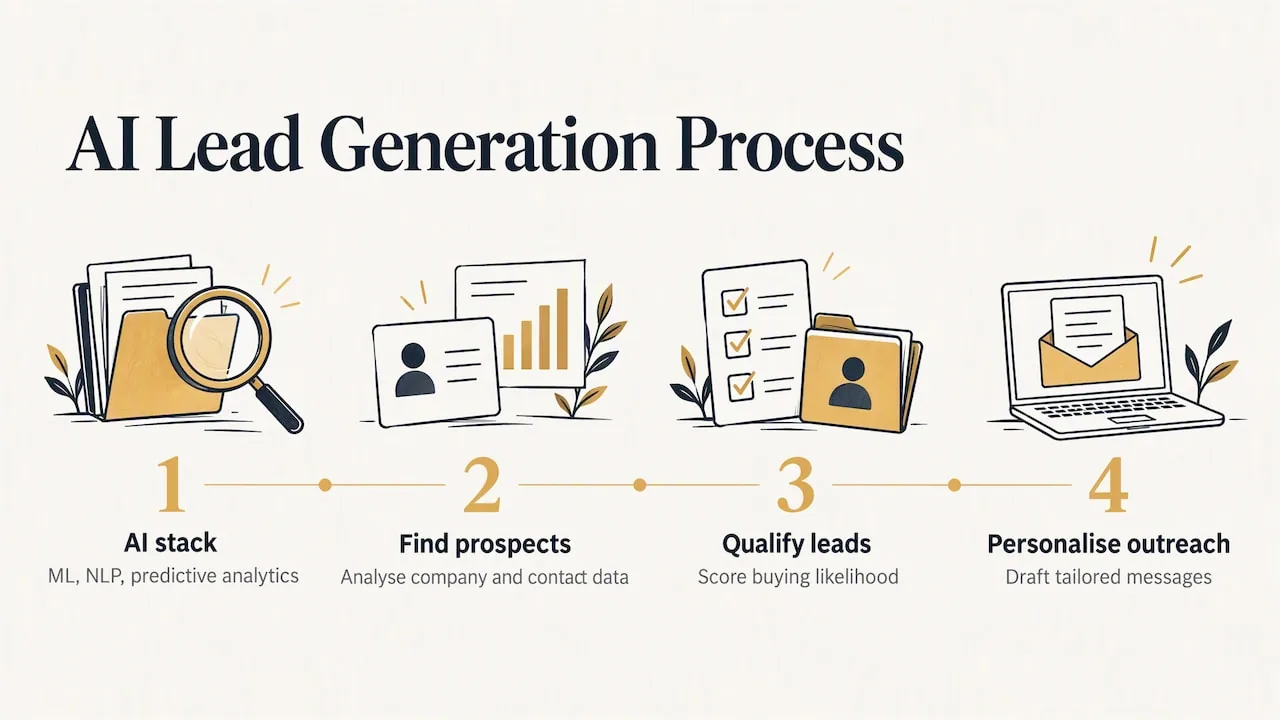
It helps to separate lead generation from the wider acquisition process. IONOS UK’s guide frames lead generation as collecting contact details and interest information, often turning anonymous website visitors into identifiable leads. Acquisition then continues through qualification, targeted contact and conversion. AI can sit in both stages, but they need different controls.
Where AI helps, and where it does not
The useful question is not “can AI generate leads?” but “which steps in our process are repetitive enough to automate safely?” Here is how the main tasks break down.
| Task | What AI does | What a person should still own |
|---|---|---|
| Prospect research | Finds companies that resemble your best customers and extracts contact details | Defining who is a good fit and who is off limits |
| Data enrichment | Fills gaps in company and contact records | Spot-checking accuracy and removing stale records |
| Lead scoring | Ranks prospects by fit and likely intent | Agreeing what a “qualified” lead means with sales |
| Outreach drafting | Produces personalised first-touch emails and messages | Reviewing every message before it goes out |
| Website engagement | Chatbots answer simple questions and capture details | Handling complex, high-value or sensitive enquiries |
| Follow-up | Triggers sequences and reminders | Judgement on timing, tone and the sales call itself |
Salesforce lists chatbots, customer segmentation, predictive lead scoring, automated email campaigns and social-media listening as the core uses, noting that they automate repetitive work while helping teams target, qualify and nurture prospects.
The pattern in that table matters. B2B workflow guidance from B2B Pipeline argues that AI is strongest where work is repetitive and outputs can be checked, while people should keep responsibility wherever credibility, commercial judgement or relationship context is involved. That is a sensible rule for deciding what to automate first.
A practical workflow, step by step
Most credible guides describe a similar sequence: data collection and enrichment, ideal-customer-profile matching, scoring, intent detection, outreach, CRM synchronisation and continuous improvement, as eWeek’s workflow guide lays out. Here is a version you can adapt.
- Define your ideal customer profile (ICP). Start with your best existing customers: sector, size, location, the problem they bought to solve and how long they took to decide. AI can only find more of what you describe clearly.
- Clean the data you already have. eWeek’s point is that model usefulness depends on data quality: stale or incomplete records lead to wrong prioritisation and routing. Deduplicate, remove dead contacts and standardise fields before automating anything.
- Build and enrich prospect lists. Warwick Business School explains that AI can crawl the web, use natural-language processing to spot companies resembling existing customers and extract contact information for sales staff. Keep a record of where each contact came from, because you will need it for compliance.
- Score and prioritise. Scores can be learned from historic similar leads and, in marketing automation, shift with email opens, clicks and website behaviour, as the same Warwick piece explains. Agree a threshold with sales for when a lead is worth a call.
- Personalise outreach, then review it. AI drafts, a person approves. HubSpot’s guidance also stresses reviewing AI-generated outreach before sending, and generic, over-automated messages are the quickest way to damage your sender reputation.
- Qualify inbound enquiries. IONOS UK says AI agents can answer first questions from website chat, forms, email or campaigns, ask about needs, budget, timeframe or company size, detect buying signals and forward promising contacts to sales. Set clear rules for when the bot hands over to a human.
- Route, log and learn. Qualified prospects go to the right person, with context, and every touchpoint is logged in the CRM so you can see what worked.
IONOS UK’s broader view is worth keeping in mind: AI works best as part of an integrated marketing and sales capability, not as a single tool dropped into an unchanged workflow. Reliable data, clear goals, suitable processes and human oversight remain essential.
AI inside paid and search channels
Not all AI lead generation means outbound tools. Much of it now happens inside the ad platforms and in search itself. Google’s Think with Google says its AI-powered campaigns analyse billions of signals in real time to find demand and connect businesses with prospects more likely to become high-quality leads. The same page, which reports US data from September 2025, says 60% of potential lead-generation customers who saw an AI Overview found decisions faster, easier or less overwhelming.
Two practical consequences follow. First, the quality of what you feed the platform (conversion tracking, offline conversion data, clear landing pages) determines what the automation optimises for. Second, buyers increasingly meet answers from AI search before they ever visit a site, so being cited accurately in those answers is becoming part of lead generation. We cover that side in our guides to what AI SEO is and what Generative Engine Optimisation involves.
Can ChatGPT generate leads?
Not on its own, but it can support parts of the process. Zapier notes that ChatGPT can personalise outreach messages and, when connected to other apps, pull enrichment data, update CRM records and kick off outreach sequences. Realistic uses include:
- drafting variations of outreach for different segments, for a person to edit
- summarising a prospect’s website or recent news before a call
- turning customer interviews into ICP descriptions
- drafting answers for a website FAQ or chatbot
What it cannot do reliably is verify that a contact exists, that an email address is valid or that you have the right to contact someone. Those checks sit with your data sources and your compliance process. If you are comparing assistants for marketing tasks, our chatbot comparison is a useful starting point.
UK rules you need to build in from day one
This is where many AI lead generation programmes fall down. The ICO’s position is that automation does not reduce your obligations: privacy by design, lawful basis, transparency, accuracy, retention, objection rights and PECR controls all apply to AI-assisted marketing.
The points that matter most for lead generation:
- Plan compliance first. The ICO says to build data protection and PECR compliance into direct marketing from the outset: decide your lawful basis, keep data accurate and no longer than needed, and follow channel-specific rules. Automated marketing calls require specific consent.
- Be open about what you collect. The ICO’s direct marketing checklist expects privacy information and an explanation of intended marketing, respect for objections, fair and transparent use of publicly available information, careful checks on bought or rented lists, and fair, disclosed profiling.
- Know the profiling rules. The ICO’s guidance on automated decision making and profiling explains that tailoring marketing through profiling is not automatically barred by Article 22, which needs both no human involvement and a legal or similarly significant effect. Marketing profiling must still respect objection rights and PECR, and vulnerable groups deserve extra care.
- Honour the right to object. The ICO’s legal framework page states that individuals have an absolute right to object to profiling for direct marketing.
- Social media is not a loophole. The ICO confirms that direct marketing to social-media users must comply with both PECR and UK GDPR.
- Nuisance marketing can be an offence without a connection. The government’s Data (Use and Access) Act factsheet on PECR notes that PECR’s definitions cover calls and communications even when they do not reach the intended recipient.
For a wider view, the ICO’s artificial intelligence hub offers risk toolkits for assessing the effect on people’s rights and freedoms. Our own GDPR marketing checklist turns the basics into a practical list. If your processing is high risk, speak to your data protection officer or a qualified adviser before launching.
Choosing AI lead generation tools
Resist starting with a tool shortlist. Start with these questions instead:
- Where does the data come from? Can the supplier show the source of contact data and explain how it meets UK GDPR and PECR?
- Does it fit your stack? It should sync cleanly with your CRM, so records are not duplicated or left unrouted.
- Can you see why a lead was scored as it was? If sales cannot understand the score, they will not trust it.
- What controls exist for review? Look for approval steps before outreach is sent, and easy suppression of people who object.
- Who maintains it? Tools drift. Someone needs to own the prompts, rules and data hygiene every month.
For most businesses, the constraint is not software but the time and expertise to set it up, connect it to measurement and keep it compliant. That is a good reason to look at the whole system, including what a B2B demand generation service should deliver, before adding point solutions.
Measuring whether it works
More leads is not the goal. Better pipeline is. A sound measurement approach looks like this:
- Set a baseline. Record performance across at least one full sales cycle before AI changes anything.
- Tag AI-touched records in your CRM so you can separate AI-sourced leads (found by AI) from AI-influenced ones (nurtured or scored by AI).
- Report monthly on AI-sourced and AI-influenced pipeline, conversion rate by stage and the change in customer acquisition cost against the baseline.
- Connect to revenue. Leadership will want to see activity and efficiency metrics linked to pipeline, revenue, acquisition cost, lifetime value and return on marketing investment.
- Review lead quality with sales every month. If sales say the leads are poor, no dashboard should overrule that without investigation.
A longer sales cycle means a longer baseline: a business with a six-month cycle cannot judge a new process in six weeks. Our piece on data-led decision making and marketing ROI goes deeper on tying marketing activity to outcomes.
Our perspective
We see the same pattern with most clients: AI does not fix a weak offer, a vague audience or messy tracking. It makes whatever is already there faster. If your ICP is sharp and your reporting reaches real enquiries and revenue, AI multiplies that. If not, it multiplies the noise.
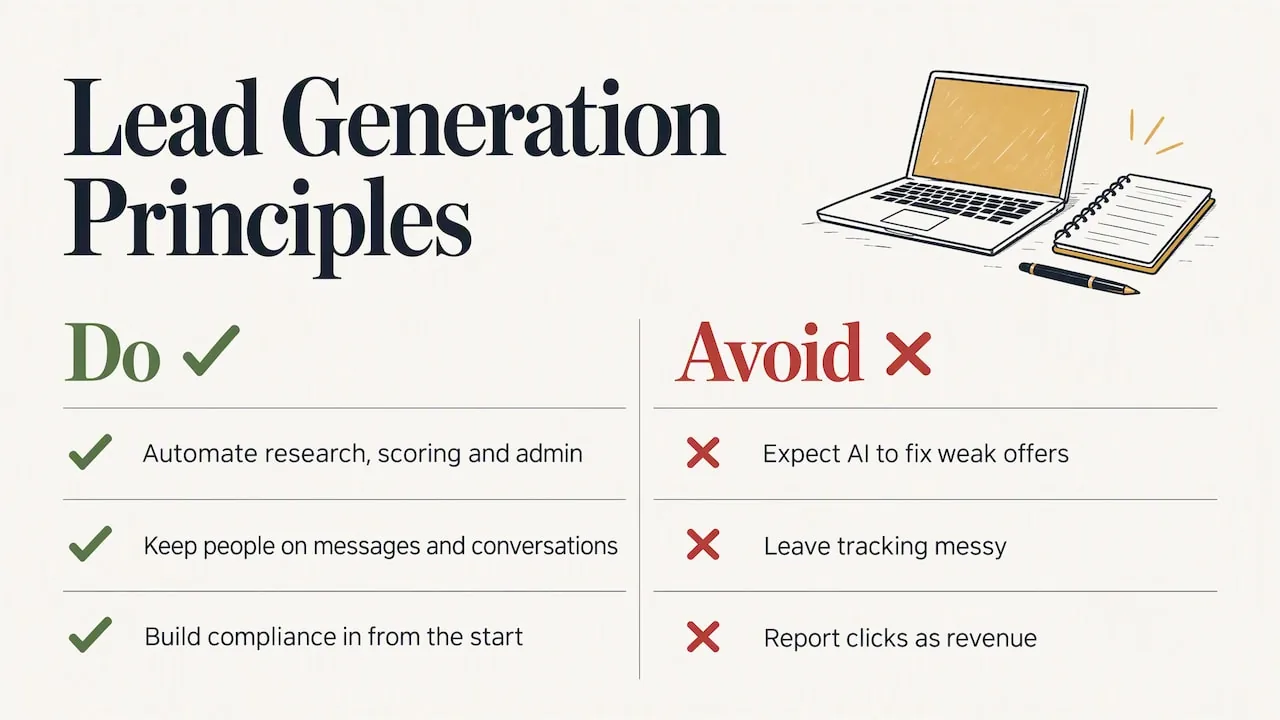
That is why we treat lead generation as one system. Search visibility (including visibility in AI-generated answers), paid media, landing pages and reporting are delivered by one in-house team, so the leads we report are tied to actual enquiries and revenue rather than to clicks. We would rather show you a smaller number of leads that sales wants to call than a large number that nobody follows up.
Our advice is to automate the research, the scoring and the admin, keep people on the message and the conversation, and build compliance into the process rather than bolting it on afterwards. The businesses that start with that discipline now will be better placed as buyers rely more on AI answers and AI-assisted ads.
How Castle can help
If you want AI-supported lead generation without assembling the stack yourself, our lead generation service combines paid media, search and conversion work under one team, with reporting tied to enquiries and revenue. We can also advise on how your business appears in AI search through AEO and GEO.
You can see everything we offer, from Google Ads and Meta Ads to ChatGPT Ads and AI consulting, on our services page. Pricing is scoped to your goals, so the first step is a conversation about what you need.
FAQ
Can you use AI to generate leads?
Yes, for specific parts of the process. AI can build prospect lists, enrich contact records, score leads, draft personalised outreach and handle first-line website enquiries. It works best when your ideal customer is clearly defined and a person reviews what goes out.
Are AI leads worth it?
They can be, if you judge them by pipeline and revenue rather than volume. Compare conversion by stage and acquisition cost against a baseline from before you introduced AI. If sales reject the leads, the process needs fixing before it needs scaling.
Is AI lead generation legal in the UK?
It can be, provided you follow UK GDPR and PECR. That means a lawful basis, clear privacy information, respect for objections and channel-specific consent, for example for automated marketing calls. The ICO’s direct marketing guidance is the place to check, and a data protection adviser can confirm your specific set-up.
Can ChatGPT generate leads?
It can help with drafting outreach, summarising prospects and updating records when connected to other tools, but it does not find verified contacts or confirm you may contact them. Treat it as an assistant inside a process, not a lead source.
Sources
- Zapier: What is AI lead generation?
- IBM: AI for Lead Generation
- IONOS UK: How can businesses acquire customers using AI?
- Salesforce: AI Lead Generation Fundamentals
- B2B Pipeline: AI in B2B demand generation
- eWeek: How AI Lead Generation Software Works
- Warwick Business School: Six ways AI is taking over sales
- HubSpot: AI Sales Prospecting guide
- Think with Google: How to land high-quality leads with AI
- ICO: Plan direct marketing
- ICO: Direct marketing checklist
- ICO: Automated decision making and profiling
- ICO: Legal framework
- ICO: Previously asked questions
- GOV.UK: Data (Use and Access) Act factsheet on PEC Regulations
- ICO: Artificial intelligence