AI Search · 13 min read
AI SEO Agency: What They Do and How to Choose One
What an AI SEO agency actually does, how it differs from traditional SEO, what to ask before you sign, and how UK businesses should measure results.

On this page — 13 sections
- TL;DR
- Table of Contents
- What an AI SEO agency actually does
- How AI SEO differs from traditional SEO
- What the work looks like in practice
- How to measure AI SEO, GEO and AEO
- Which businesses benefit most
- What to check before you appoint an agency
- Our perspective
- Working with Castle
- FAQ
- Sources
- Recommended
An AI SEO agency helps your business earn visibility in Google and in AI-generated answers from tools such as ChatGPT, Gemini and Google’s AI Overviews. The good ones do this by building on proven SEO foundations (technical health, useful content, authority) and then adding work aimed at being cited in answers, not only ranked in a list of links. This guide explains what that work involves, where the claims end and the evidence begins, and what a UK business should check before signing a retainer.
Make your brand visible in AI search. Castle combines traditional SEO, GEO and AEO to help businesses improve search visibility and attract high-quality leads.
TL;DR
- AI SEO is an extension of SEO, not a replacement. Google states that there are no additional technical requirements for AI Overviews or AI Mode beyond being indexed and eligible for ordinary Search.
- A credible agency improves content quality, technical health, authority and brand mentions, then measures AI visibility alongside enquiries and revenue.
- Be wary of guarantees, mass-produced pages and reports that stop at citation counts.
- Ask for previous work, realistic timeframes, measurement methods and a record of every change made to your site.
- Castle runs traditional SEO, GEO and AEO through one in-house team, with reporting tied to enquiries and revenue.
Table of Contents
- What an AI SEO agency actually does
- How AI SEO differs from traditional SEO
- What the work looks like in practice
- How to measure AI SEO, GEO and AEO
- Which businesses benefit most
- What to check before you appoint an agency
- Our perspective
- Working with Castle
- FAQ
- Sources
What an AI SEO agency actually does
The label covers a lot of ground, so it helps to separate the work from the branding. In practice an AI SEO agency does four things.
- Audits how you appear today. That means technical SEO, content coverage, and how your brand is described when someone asks an AI tool about your category.
- Fixes the foundations. Crawlability, indexation, site structure, internal links and page experience.
- Builds content and authority that answer engines can use. Expert-led pages, clear answers to real questions, and mentions on sites that AI tools and search engines trust.
- Measures and adjusts. Rankings, AI visibility, enquiries and revenue, reviewed regularly.
Google itself lists the services a good SEO provider might offer: reviewing site content and structure, technical advice, content development, keyword research, training and optimisation for generative AI. Notice that the AI element sits alongside the classic services rather than replacing them.
If you want the terminology unpacked, our AEO, GEO and AI SEO glossary defines each term, and what is AI SEO gives the longer introduction.
AI SEO, GEO and AEO: the same job, different targets
The three terms overlap, and agencies use them loosely.
- AI SEO is the broad umbrella: SEO that accounts for AI features in search and AI assistants.
- Generative Engine Optimisation (GEO) focuses on being included and cited in answers generated by large language models.
- Answer Engine Optimisation (AEO) focuses on being the direct answer to a question, whether in a featured snippet, a voice result or an AI response. Our explainer on answer engine optimisation covers this in detail.
The practical point: the three share most of their work. A page that is clear, accurate, well structured and backed by a credible brand tends to serve all three.
How AI SEO differs from traditional SEO
The honest answer is that the foundations are the same and the emphasis shifts.
Google’s guidance is direct on this. To appear as a supporting link in AI features, a page must be indexed and eligible to show in Search with a snippet, and Google says no special AI files or markup are needed. It also notes that meeting the requirements does not guarantee crawling, indexing or serving. Any agency that promises a guaranteed AI citation is promising something Google itself does not.
Where the emphasis does shift:
| Area | Traditional SEO focus | AI SEO addition |
|---|---|---|
| Success measure | Rankings and organic clicks | Citations, brand mentions and share of voice in answers, plus clicks and enquiries |
| Content | Keyword-targeted pages | Pages that answer whole questions clearly, with sources, data and expert input |
| Authority | Backlinks | Backlinks plus brand mentions on publications and specialist sites |
| Technical | Crawl, index, speed | The same, plus making key information available as text rather than locked in images or scripts |
| Reporting | Position tracking | Prompt-based visibility tracking, treated as directional |
Our comparison of AI SEO and traditional SEO helps you judge which mix your business needs, and GEO vs traditional SEO: what changed in 2026 covers the shift in more depth.
What the work looks like in practice
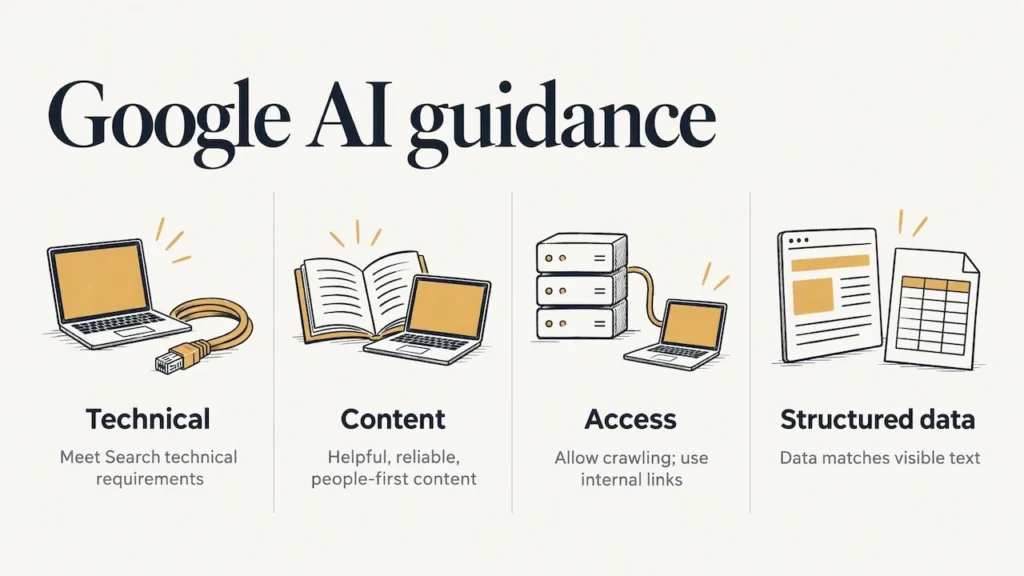
Google’s own recommendations for appearing in its AI features are a useful checklist, because they show what is real and what is marketing. It advises meeting Search technical requirements, creating helpful, reliable, people-first content, allowing crawling, using internal links, providing a good page experience, making important content textual and making sure structured data matches visible text. For local and ecommerce businesses it also points to keeping Business Profile information up to date and using Merchant Center where appropriate.
That translates into a workplan like this.
1. Technical foundations
A technical audit comes first. If key pages are blocked, slow, duplicated or poorly linked, nothing built on top of them will perform. This is unglamorous work and it is where many AI SEO projects are won or lost. A solid on-page SEO checklist is a good way to see how much of the basics still decides visibility, whichever interface the searcher uses.
2. Content that deserves to be cited
Google says unique, compelling and useful content is likely to influence a site’s presence in generative AI search more than other suggestions in its guide. The same page warns that creating many pages mainly to manipulate rankings or AI responses breaks its scaled content abuse policy.
So good agencies write fewer, better pages: service and location pages with real detail, expert-led articles, clear answers to the questions your buyers ask, and original data where you have it. Our guide to which keywords to target shows how that starts with understanding demand.
3. Evidence inside the content
There is early academic evidence on what makes content more likely to be surfaced by generative engines. A paper on UK iGaming, summarising an earlier study of about 10,000 queries, reports relative visibility gains of 40% for citing sources, 37% for adding statistics and 22% for adding quotations, while keyword stuffing’s 3% gain was not significant. Treat that as a pointer, not a promise: it comes from one sector’s benchmarking paper and describes an earlier study. But it fits common sense. Content that shows its evidence is easier to trust.
4. Authority beyond your own site
AI tools do not only draw on brand websites. An analysis of almost 200,000 citations from commercial-intent ChatGPT prompts in the UK in January 2026 found that niche or specialist publishers and brand sites each accounted for 25%, traditional media 15% and Reddit under 2%, with patterns varying by vertical. For a UK business, that argues for digital PR, regional link-building and presence on the specialist publications your buyers read, not only on-site work.
5. Accuracy and human oversight
AI can speed up research and drafting, but Google warns that generative models can produce inaccuracies and says AI-assisted content must be manually fact-checked for accuracy and trustworthiness before publication. An agency that publishes unreviewed machine output at scale is taking a risk with your brand. Ask who edits, who fact-checks and who signs off.
How to measure AI SEO, GEO and AEO
Measurement is where the weakest agencies hide. AI answers vary by prompt, by user and by day, so a screenshot of one response proves little.
The PRCA’s guidance on measuring GEO suggests tracking AI visibility by topic, share of voice, net sentiment, cited URLs, branded-search trends, key event completions and answer accuracy, and treating AI outputs as directional rather than definitive. It also frames visibility as a funnel from presence and reach through to quality, behaviour and commercial outcomes, and cautions that citation counts alone are vanity metrics rather than proof of revenue.
In practice, a sensible report includes:
- Visibility: how often and how accurately you appear for a fixed set of commercially relevant questions.
- Traffic quality: organic sessions, and referrals from AI tools where they can be identified.
- Demand signals: branded search growth, direct visits.
- Outcomes: form fills, calls, bookings and sales, attributed as honestly as your analytics allow.
If a monthly report never mentions enquiries or revenue, it is describing activity, not results.
Which businesses benefit most
AI SEO is not only for large brands. It tends to pay back fastest where buyers research before they buy and where trust matters.
- B2B and lead generation businesses. Buyers increasingly ask AI tools to shortlist suppliers. Being described accurately in those answers matters. Our guide to B2B demand generation services covers how this fits with wider demand work.
- Ecommerce brands. Product visibility depends on feeds, category content, reviews and technical health. See ecommerce marketing in 2026 and how SEO and paid ads work together.
- Local and trade businesses. Location pages, Business Profile accuracy and local reviews carry most of the weight. Our page on marketing for trades businesses goes further.
- Smaller firms generally. The case for investing in search at all is set out in why SEO matters for small businesses.
What to check before you appoint an agency
Google’s advice on hiring an SEO is a good starting point, and it applies equally to AI-focused providers. It recommends asking for examples of previous work, realistic timeframes, how results will be measured, relevant industry and geographic experience, communication arrangements and a record of changes made to your site.
Turn that into a shortlist of questions:
- Can you show work for businesses like mine? Look for outcomes in enquiries or revenue, not just traffic charts.
- What will you do in the first 90 days? Expect an audit, a prioritised plan and early technical fixes, not a promise of instant citations.
- How do you measure AI visibility? Ask which prompts, how often, and how you separate noise from signal.
- Who does the work? Find out whether strategy, content, technical and paid specialists are one team or a chain of subcontractors.
- How do you use AI in your own process? Look for human editing and fact-checking.
- What will you log and share? You should receive a clear record of every change.
- What happens if results are slow? An honest agency explains the variables. Google notes that meeting requirements does not guarantee crawling, indexing or serving, so nobody can promise placement.
Red flags
- Guaranteed rankings or guaranteed AI citations.
- Hundreds of near-identical pages generated to cover every keyword variation.
- Special “AI files” or markup sold as essential, when Google says they are not required.
- Reports that celebrate impressions or mentions but never connect to the sales pipeline.
- No named people, no process and no access to your own data.
Our breakdown of what an AI SEO agency should deliver gives a fuller deliverables list you can compare proposals against.
Our perspective
We have been doing SEO since 2014, and the biggest change we see is not that the rules were rewritten. It is that more of the buying journey now happens before a click. A prospect asks an AI tool for a shortlist, reads a summary, and only then visits a site, often by searching your brand name.
That is why we run traditional SEO, GEO and AEO as one programme. The technical and content foundations that win in Google are the same ones that make a business easy for AI tools to understand and cite. Splitting them into separate projects with separate teams tends to create gaps.
Two principles guide how we work:
- Tie everything to enquiries and revenue. Visibility is useful only if it produces leads and sales, so our reporting follows the path from visibility to outcome rather than stopping at mentions.
- Keep the team in-house. Strategy, content, technical work, paid media and development sit with one team, so a finding in one area reaches the others quickly. Our view of what has and has not shifted is in SEO in 2026: what still works and what doesn’t.
We would rather tell you that AI visibility is directional and takes sustained work than sell a shortcut that does not exist.
Working with Castle
Castle is a UK agency that combines AI-driven SEO, GEO and AEO with technical SEO audits, local SEO, expertise-led content, digital PR and regional link-building. Because Google Ads, Meta Ads, ecommerce marketing, lead generation and Shopify development sit under the same roof, the organic and paid sides of your acquisition can be planned together.
If you want to see how your business currently shows up in search and AI answers, and what a sensible plan would look like, start with our full list of services or talk to the team through castle.co.uk. We work with B2B and direct-to-consumer brands, in ecommerce and lead generation, on retainer for ongoing SEO and paid media and on a project basis for web development and content.
FAQ
Is AI SEO different from normal SEO?
Mostly it builds on it. Google says pages need to be indexed and eligible for Search to appear in AI features, with no extra technical requirements. The difference is in emphasis: more attention to clear answers, evidence, brand mentions and measuring visibility inside AI responses.
How long does AI SEO take to work?
It depends on your starting point, competition and how much technical work is needed. Google advises asking any SEO for realistic timeframes, and you should be wary of anyone who promises fast, guaranteed placement. Expect early technical and content improvements first, with commercial results building over months.
Can an agency guarantee my business will be cited by ChatGPT or Gemini?
No. AI answers vary and no one controls them. Even Google says that meeting its requirements does not guarantee crawling, indexing or serving. A good agency improves your odds and measures progress honestly.
How do I know if AI SEO is working?
Look beyond mentions. The PRCA suggests tracking topic-level visibility, share of voice, sentiment, cited URLs, branded search and key events, and warns that citation counts alone do not prove revenue. Ask for reporting that links visibility to enquiries and sales.
Is it safe to use AI-written content for SEO?
Only with human oversight. Google says AI-assisted content should be manually fact-checked and should meet its quality and spam policies, and that generating many pages without adding value may breach its scaled content abuse policy.
Sources
- AI Features and Your Website, Google Search Central
- Google’s Guide to Optimizing for Generative AI Features on Search
- Google Search’s Guidance on Generative AI Content on Your Website
- Do You Need an SEO? Tips for Hiring an SEO, Google Search Central
- How to Measure GEO, PRCA Global
- Algorithmic Trust and Compliance: Benchmarking Brand Visibility (arXiv)
- Which sites really influence AI Search in the UK, Obsero
- On-Page SEO: 10 Step Checklist To Improve Your Google Rankings