AI Search · 17 min read
How to choose an AI SEO agency: what the services include, what they cost and what to ask
What AI SEO and GEO services should include, what the first 90 days should look like, how to measure the work, what it costs, and the questions and red flags to check before you sign.

On this page — 11 sections
- What does an AI SEO or GEO agency actually do?
- How do AI tools decide which businesses to mention?
- What should AI SEO services include?
- What should happen in the first 90 days?
- How do you measure AI SEO and GEO?
- How much do AI SEO and GEO services cost?
- What questions should you ask before hiring an AI SEO agency?
- What are the red flags?
- Which businesses benefit most from AI SEO?
- Our perspective
- FAQs
To choose an AI SEO agency, judge every proposal on four things: whether the work builds on proven SEO foundations, whether it lists named deliverables rather than “AI optimisation”, whether progress is measured against a fixed baseline and tied to enquiries, and whether the agency refuses to guarantee AI citations. Get those right and the label on the proposal (AI SEO, GEO or AEO) matters far less than the work underneath it.
This guide covers what AI SEO and GEO services should include, what the first 90 days should look like, how to measure the work, what it costs and the questions to ask before you sign. We run an AI SEO agency team and a GEO agency service ourselves, so we’ve tried to write the guide we’d want a client to read before talking to us or anyone else.
What does an AI SEO or GEO agency actually do?
An AI SEO agency helps your business get found, cited and described accurately in AI-generated answers from Google’s AI Overviews and AI Mode, ChatGPT, Gemini, Perplexity and Copilot, as well as in normal search results. The good ones build on SEO fundamentals and then add work aimed at being cited in answers, not only ranked in a list of links.
You’ll see three labels for overlapping work:
- AI SEO is the umbrella: SEO that accounts for AI search features and assistants.
- Generative engine optimisation (GEO) focuses on being included and cited in answers written by large language models. Our guide to what GEO is covers it in full.
- Answer engine optimisation (AEO) focuses on being the direct answer to a question. See our AEO explainer.
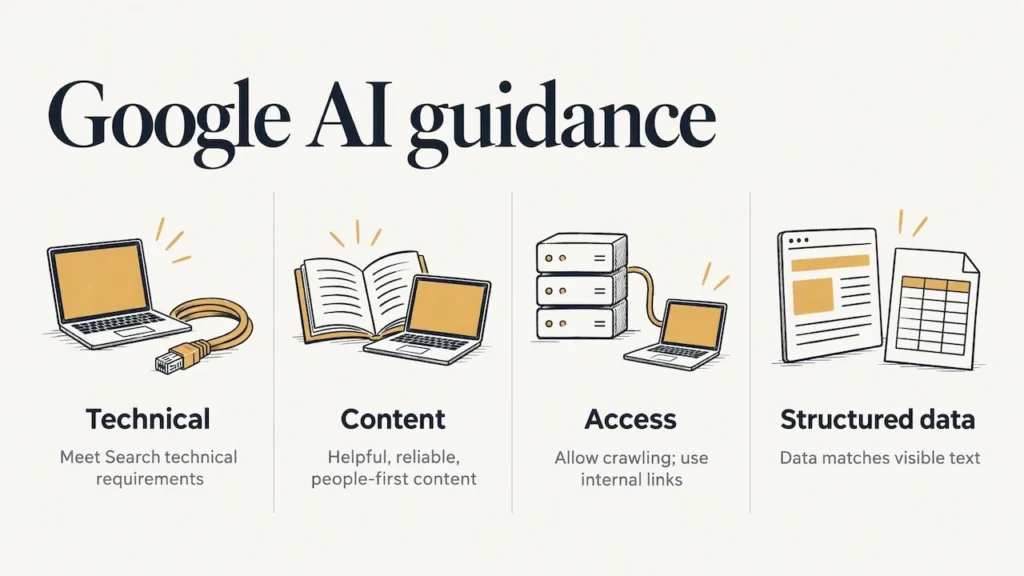
Google’s own position is that this is all SEO. Its guide to generative AI search says optimising for generative AI search “is optimizing for the search experience, and thus still SEO”. Its advice on hiring an SEO now lists “optimizing for generative AI” alongside content reviews, technical advice, keyword research and training. The AI element sits next to the classic services, not instead of them.
In practice the work falls into five areas: technical foundations, content worth citing, evidence inside that content, authority beyond your own site, and accuracy with human oversight. Everything else in a good proposal hangs off those.
How do AI tools decide which businesses to mention?
AI tools cite pages their own search retrieves, and they name brands they already know. That’s the short version of the most useful research published on the subject so far, and it should shape which agency you hire.
In October 2026, University of Toronto researchers published What Drives AI Citations?, which tracked 651 questions daily for three months across ChatGPT, Gemini and Perplexity and collected 143,249 answers. Their main findings:
- Retrieval decides most of it. Every page ChatGPT cited was one its own search had retrieved. Retrieval explained 32% of the variation in citations between pages of a site, against 2.8% for page properties such as structure and wording.
- The engines rewrite your question. Each question is turned into new sub-queries on every answer. Google calls the same thing “query fan-out”: running multiple related searches across subtopics and data sources.
- Brands get named from memory. In 46% of ChatGPT’s mentions of brands the question didn’t name, no cited page supported the mention. As the authors put it, pages are cited when they’re searched, and brands are named when they’re remembered.
One caveat: the main dataset covers a single US market (fibre broadband), so the exact percentages won’t transfer to a Leeds accountancy firm or a Shopify homeware brand. The direction is what matters, and it matches what we see when we track client prompts.

That gives you a simple way to read a proposal. There are two big levers and one small one:
- Get retrieved. Pages must be crawlable, indexed and answer the sub-questions an engine generates.
- Get remembered. Your brand must be described consistently and credibly across the web.
- Polish the page. Clear structure and direct answers still help, but they explain far less.
An agency whose whole offer is “we’ll restructure your pages for AI” is working on lever three. That’s useful. It just isn’t the main event.
What should AI SEO services include?
A complete AI SEO or GEO service should include eight deliverables. Use this as a checklist when you compare proposals, because “we optimise for ChatGPT” isn’t a deliverable.
1. An AI visibility baseline
The project should start with a documented baseline across an agreed list of buyer questions, run on each platform that matters to you. It should show where your brand is mentioned or cited, which competitors appear instead, which websites are used as sources, how your brand is described, and anything inaccurate or out of date. Every later result gets measured against this.
2. A technical and crawler audit
AI visibility depends on crawlability and indexing first. Google says a page needs to be indexed and eligible to show with a snippet to appear as a supporting link in AI Overviews or AI Mode, with no additional technical requirements. Its checklist includes making sure crawling is allowed “by any CDN or hosting infrastructure”, not just robots.txt.
ChatGPT has its own crawlers. OpenAI says sites that opt out of its search crawler, OAI-SearchBot, won’t be shown in ChatGPT search answers, while GPTBot (its training crawler) is controlled separately. We regularly find robots.txt files, security plugins or CDN firewall rules blocking the search bot by accident because someone blocked “AI bots” in one go. Five minutes to check. Months of invisibility if nobody does. Look for an agency that does this as part of genuine technical SEO, not an automated checklist.
3. An entity and brand consistency audit
This is the “get remembered” lever, and it’s where many proposals are thinnest. The agency should map how your business is described across your site, Google Business Profile, directories, review sites, social profiles and press: names, services, locations, leadership, authors and credentials. Outdated descriptions, mismatched service names and duplicate location data all make it harder for an AI model to form a clear picture of you.
4. Question-led content
Because engines fan a question out into sub-queries, your content needs to answer the questions buyers actually ask, clearly and early on the page. A credible plan combines keyword data (established demand) with research into the longer, conversational questions people put to AI tools, and covers the whole buying journey:
- What the category is and whether you need it
- Problem and solution questions
- Comparisons between options and providers
- Costs and pricing
- Sector and location variations
- Evidence: case studies, results and named experts
Google says that creating content people find “unique, compelling, and useful” will likely influence your presence in generative AI search more than any other suggestion in its guide. The same guide warns that churning out pages for every possible fan-out query, mainly to manipulate rankings or AI answers, breaks its scaled content abuse policy. Fewer, better pages win.
5. Structured data that matches the page
Schema markup helps search engines understand a page, and it’s worth doing properly: Organisation, LocalBusiness, Service, Product, Article and author markup as the content warrants. It must match what’s visible on the page. Google is clear that there’s no special schema needed for AI Overviews or AI Mode, so be wary of anyone selling “AI markup” as the secret ingredient.
6. Authority, mentions and digital PR
AI tools don’t only draw on brand websites. Obsero analysed almost 200,000 citations from commercial ChatGPT prompts in the UK in January 2026 and found specialist publishers and brand sites each accounted for 25%, traditional media 15% and Reddit under 2%. Separately, Ahrefs found branded web mentions correlated far more strongly with AI Overview visibility than backlinks did (0.664 against 0.218, across 75,000 brands).
For a UK business, that argues for digital PR, regional link-building, reviews and presence on the specialist publications your buyers read. A proposal that’s entirely on-site work is missing half the job.
7. Accuracy and human oversight
AI can speed up research and drafting, but Google warns that generative models can produce inaccuracies and says it’s “critical to manually factcheck and review all AI-generated content”. Ask who writes, who edits, who fact-checks and who signs off. An agency publishing unreviewed machine output at scale is taking a risk with your brand.
8. Reporting tied to enquiries and revenue
The final deliverable is a report that connects visibility to commercial results. More on what that should contain below. If a monthly report never mentions enquiries or revenue, it’s describing activity, not results.
| Deliverable | What you should receive | Red flag |
|---|---|---|
| Baseline | A fixed prompt list with results per platform | A few screenshots |
| Technical audit | Crawl, index and AI crawler checks, including CDN rules | “We added an llms.txt” |
| Entity audit | A list of inconsistencies and fixes across the web | Nothing beyond your website |
| Content | A plan mapped to buyer questions and stages | Hundreds of near-identical pages |
| Structured data | Validated markup that matches the page | “Special AI schema” |
| Authority | Named PR and mention targets | No off-site work at all |
| Oversight | Named editors and a fact-checking step | Unreviewed AI copy |
| Reporting | Visibility next to traffic, enquiries and revenue | Mentions only |
What should happen in the first 90 days?
A sensible engagement follows a clear sequence, and a reputable agency should be able to describe each stage without jargon. Expect something like this:
Days 1 to 30: baseline and fixes. Discovery of your offer, customers and goals. Technical and AI visibility audits. Agreement on the platforms and prompts to track. Urgent crawler and indexing problems fixed straight away, and measurement checked so you can see what happens next.
Days 31 to 60: priority pages. Your highest-value service and category pages rewritten or restructured to answer buyer questions clearly. Entity inconsistencies fixed, structured data added, internal links improved. The first new commercial content published.
Days 61 to 90: evidence and authority. Digital PR and outreach under way, case studies and original data in production, and the baseline re-run to show what’s moved and set the next quarter’s priorities.

AI answers vary between runs and platforms keep changing how they retrieve and cite, so be wary of anyone promising a fixed result by a fixed date. A credible plan promises a defined programme of work and transparent reporting.
How do you measure AI SEO and GEO?
Measure three layers: visibility in AI answers, traffic from AI and organic search, and commercial outcomes. The PRCA’s guidance on measuring GEO suggests starting with seven metrics: AI visibility by topic, share of voice, net sentiment, cited URLs, branded search trends, key event completions and answer accuracy. It also says AI outputs should be treated as “directional, not definitive”, and calls user-facing citation counts a vanity metric when they stand alone.
A few habits keep the numbers honest:
- Fix the prompt list. Agree 30 to 100 realistic buyer questions at the start and re-run the same list every month, so a change is real and not a side effect of new questions.
- Repeat each prompt. SparkToro’s research found less than a 1 in 100 chance that ChatGPT or Google’s AI would give the same list of brands twice in 100 runs. How often you appear across many runs is meaningful. Your “position” in one answer isn’t.
- Separate mentions from citations. The Toronto study shows a brand can be named with no link, and a page can be cited without the brand being named. Track both.
- Use first-party data. Google’s Generative AI performance report in Search Console shows impressions from AI Overviews and AI Mode by page, device and country. Bing Webmaster Tools’ AI Performance dashboard shows citations and the grounding queries AI used to find you.
- Ask your enquiries. Add “AI assistant (ChatGPT, Gemini and so on)” to your “how did you hear about us?” options. Referral data undercounts, because plenty of people read an AI answer and then search for you by name.
For a sense of what an honest report looks like, our HNK Solicitors case study shows AI-search citations rising from 38 in January 2026 to 163 by August 2026 (Ahrefs), with Google Analytics attributing roughly 167 sessions a month to AI assistants. The case study says plainly that volumes are small and attribution is imperfect. That’s the tone to look for. We cover how those visitors behave in do GEO leads convert better than Google leads?
How much do AI SEO and GEO services cost?
Most AI SEO and GEO work is sold as a monthly retainer, often combined with SEO, with website builds or large content projects priced as one-off fees. Prices vary with scope and competition, and few agencies publish them. One specialist in our roundup of UK GEO and AI SEO agencies lists monthly packages from £450 to £10,000 plus VAT, which gives you a sense of the spread.
The more useful question is what the work needs to return. Here’s an illustrative example with round numbers. Say a retainer costs £2,000 a month and a new client is worth £6,000 in gross margin over their first year. To break even, AI and organic search need to bring in one extra client every three months. Anything beyond that is profit. If your sales team can’t tell you where new clients come from, fix that before you hire anyone, or you’ll never know whether the work paid off.
Watch for two pricing traps:
- Paying twice. A GEO retainer stacked on top of an existing SEO retainer, with the same technical and content work billed in both.
- Tracking dressed as a service. A cheap “AI visibility” package that’s really a monthly prompt report with nothing done in between.
Check the contract as closely as the price. Ask what’s included, what’s extra, the minimum term and how you leave, and make sure accounts, content and tracking stay in your name. For what it’s worth, we work on a rolling monthly agreement with no tie-in, and we think any agency confident in its work should be able to do the same.

What questions should you ask before hiring an AI SEO agency?
Google’s advice on hiring an SEO is a good starting point, and it applies just as well to AI-focused providers. It suggests asking for examples of previous work, what results to expect and in what timeframe, how success is measured, and whether the agency will share every change it makes to your site. It also asks whether an agency’s AEO or GEO advice is aligned with Google’s official guidance. Our additions:
- What exactly will you do each month? Expect named deliverables: audits, pages, mentions earned, reports.
- Which lever does your plan pull? Ask how much goes on retrieval (crawling, indexing, answering sub-questions) and reputation (mentions, reviews, PR) versus reformatting pages.
- How do SEO and AI search fit together? Separate, competing programmes may mean paying twice. Our SEO vs GEO comparison shows how the work overlaps.
- Who does the work? Find out whether strategy, content, technical and PR specialists are one in-house team or a chain of subcontractors.
- How do you use AI in your own process? Look for human editing and fact-checking.
- What evidence can you show? Case studies with named metrics from businesses like yours: what was done, over what period, and what changed.
- Which platforms and prompts will you track, and can we export the data?
- What happens if results are slow? An honest agency explains the variables rather than promising placement.

What are the red flags?
Walk away, or at least ask some hard questions, if you see any of these:
- Guaranteed rankings or guaranteed AI citations. Google says that even a page meeting every requirement isn’t guaranteed to be crawled, indexed or served. Its hiring advice is blunter: if an SEO guarantees first place, “find someone else”.
- Hundreds of near-identical pages generated to cover every keyword or fan-out variation.
- llms.txt and “AI markup” sold as essential. Google lists these among the things you can ignore for Google Search. Other tools may read them, but they’re not a strategy.
- “Position 3 in ChatGPT” reports. AI answers reshuffle almost every time, so single positions mean very little.
- No named people, no process and no access to your own data.
For the tactics a good agency should be using, and the ones it should stop charging for, see the GEO tactics most agencies miss. If you’d like to compare specific providers, our list of UK GEO and AI SEO agencies sets out what each one publishes.
Which businesses benefit most from AI SEO?
AI SEO pays back fastest where buyers research before they buy and where trust matters. Your customers are already using these tools: Ofcom found that ChatGPT had 1.8 billion UK visits in the first eight months of 2025, up from 368 million a year earlier, and that about 30% of searches now show AI Overviews.
- B2B and lead generation firms selling considered services, where buyers ask AI tools to shortlist suppliers. Pairing AI SEO with lead generation keeps the focus on enquiries sales can act on.
- Ecommerce brands, whose products get compared and summarised by AI shopping features. Feeds, category content, reviews and technical health carry most of the weight, which is why the work sits naturally with ecommerce marketing.
- Local and regional service businesses competing for city-specific answers, where a handful of named firms often get the whole recommendation.
If you’re earlier in the journey, start with our guide to what AI SEO is or the wider AI SEO and GEO guide before committing budget.
Our perspective
We’ve been doing SEO since 2014, and the biggest change we’ve seen isn’t that the rules were rewritten. It’s that more of the buying journey now happens before a click. A prospect asks an AI tool for a shortlist, reads a summary, and only then visits a site, often by searching the brand name.
That’s why we run traditional SEO, GEO and AEO as one programme, delivered by one in-house team alongside paid media and web development. The technical and content foundations that win in Google are the same ones that make a business easy for AI tools to understand and cite, and splitting them into separate projects tends to leave gaps. We’d rather tell you AI visibility is directional and takes sustained work than sell a shortcut that doesn’t exist. If an agency, including us, can’t show you the link between AI visibility and enquiries, keep asking questions.
If you’d like to see how your business shows up in AI answers today, talk to the team and we’ll walk you through it.
FAQs
What should be included in AI SEO services?
A complete service includes an AI visibility baseline, a technical and crawler audit, an entity and brand consistency audit, question-led content, structured data that matches the page, digital PR and mention building, human fact-checking, and reporting that connects visibility to enquiries and revenue.
What are GEO services?
GEO services aim to get your brand retrieved, cited and described accurately in AI-generated answers from tools such as ChatGPT, Gemini, Perplexity and Google’s AI Overviews. In practice they cover technical access for AI crawlers, content that answers buyers’ questions, reputation work off your own site, and tracking across a fixed set of prompts.
Is AI SEO different from normal SEO?
Mostly it builds on it. Google says pages need to be indexed and eligible for normal Search to appear in its AI features, with no extra technical requirements. The differences are in emphasis: clear answers, evidence, brand mentions, AI crawler access, and measuring visibility inside AI answers.
How long does AI SEO take to work?
It depends mostly on your starting point and how much technical work is needed. Expect technical fixes and early content improvements in the first three months, with commercial results building over the following months. Be wary of anyone promising fast, guaranteed placement.
Can an agency guarantee my business will be recommended by ChatGPT?
No. AI answers change between runs, and models name brands partly from what they already know, so no agency controls the final answer. A good agency makes your brand easier to find and harder to misdescribe, then reports honestly on what changes.
Should I block AI crawlers from my website?
Only if you’ve decided you don’t want to appear in those tools. Blocking OpenAI’s OAI-SearchBot removes you from ChatGPT search answers, while GPTBot, its training crawler, has a separate setting. Many businesses allow search crawlers and make a separate decision about training crawlers.