PPC · 18 min read
Google Ads Management Cost: What UK Businesses Pay and Why
What Google Ads management really costs in the UK: typical agency-published fee ranges, how percentage, flat, hybrid and performance pricing work, what the fee should pay for, and how to judge value by cost per customer.

On this page — 13 sections
- Key points
- On this page
- How much does Google Ads management cost in the UK?
- Why are ad spend and the management fee separate?
- What are the pricing models for PPC management?
- What should the management fee pay for?
- Is an agency cheaper than a freelancer or an in-house hire?
- Why do quotes for the same account vary so much?
- How do you know if the fee is good value?
- What should a Google Ads management quote include?
- Where we stand on fees
- FAQs
- Sources
Google Ads management cost in the UK comes as two separate bills: the ad spend you pay Google for clicks, and a fee to whoever runs the account. There’s no independent survey of UK management fees, but the ranges agencies publish put small accounts at roughly £300 to £800 a month, mid-size accounts at £800 to £2,000 and large accounts at £2,000 to £5,000 or more, with percentage pricing usually 10 to 20% of spend. This guide covers how each pricing model works, what the fee should buy and how to tell whether it’s paying for itself.
If you’re comparing providers rather than prices, our Google Ads management page explains how we run accounts.
Key points
- Ad spend and the management fee are separate bills, and Google’s rules say an agency must disclose its fee.
- Typical UK fee ranges are agency-published, not survey data. Use them as a sense-check, then judge each quote on scope.
- Percentage, flat, hybrid and performance pricing each reward the agency for something slightly different.
- Work out what you can afford to pay for a customer before you compare fees. That number decides whether any fee makes sense.
On this page
- How much does Google Ads management cost in the UK?
- Why are ad spend and the management fee separate?
- What are the pricing models for PPC management?
- What should the management fee pay for?
- Is an agency cheaper than a freelancer or an in-house hire?
- Why do quotes for the same account vary so much?
- How do you know if the fee is good value?
- What should a Google Ads management quote include?
- FAQs
How much does Google Ads management cost in the UK?
For most UK small and medium-sized businesses, agency management fees land somewhere between a few hundred pounds and a couple of thousand pounds a month, on top of ad spend. Larger, multi-market or ecommerce-heavy accounts cost more. The honest caveat comes first: nobody has run an independent, UK-wide survey of what agencies charge.
Whito, an independent UK research publisher, says outright that no such survey exists and that every figure online comes from agencies describing their own market. It then lists the ranges UK agencies publish (it uses one agency’s guide, updated August 2026) as a sense-check:
| Account size | Typical management fee |
|---|---|
| Small | Roughly £300 to £800 a month, or 10 to 20% of ad spend |
| Mid-size | £800 to £2,000 a month |
| Large | £2,000 to £5,000+ a month |
Typical ranges as published by UK agencies and collated by Whito (2026). Not an independent market survey.
US figures run higher. Writing in Search Engine Journal’s Ask A PPC column in April 2025, Navah Hopkins put flat-rate management at roughly $2,500 to $10,000 a month, climbing as creative, advanced tracking and frequent changes are added. Her opening point is the one to remember: there’s no fixed rate for PPC management.
Use the table to spot outliers, not to set a price. A £150-a-month quote for a 300-product Shopping account means corners are being cut, and £4,000 for one local search campaign means you’re paying for things you don’t need.
Why are ad spend and the management fee separate?
Your ad spend goes to Google. The management fee goes to the person or agency doing the work. Keeping them apart is how you see exactly how much money reaches the auction, and Google’s rules back you up on that.
Under Google’s third-party policy, an agency that charges a management fee separate from the cost of Google Ads has to tell new customers in writing before the first sale and show the fee on invoices. If it sends monthly performance reports, those must include costs, clicks and impressions, with the cost being the exact amount Google charged, excluding the agency’s fees. Google’s advertiser guide to working with third parties adds that you have a right to know the clicks, impressions and cost of your ads, and that you should get your agreement in writing.
A quote of “£2,000 a month, all in” that doesn’t say how much is media is a red flag. You can’t judge a fee you can’t see.
How the ad spend side behaves
You set an average daily budget, and Google charges per click on most search campaigns. On busier days Google can spend up to twice your average daily budget, but across a month you won’t be charged more than the daily budget multiplied by 30.4, the average number of days in a month.
With round numbers: set £50 a day and one Tuesday might cost £90 while Wednesday costs £20. Don’t panic. Your monthly ceiling is £50 × 30.4 = £1,520. A decent manager reports against the month and explains the swings before you have to ask.

What the clicks themselves cost depends heavily on your sector. There’s no credible UK-wide average cost per click, so the most quoted benchmark is American: LocaliQ’s 2026 search benchmarks put the average cost per click at $5.42 and the average cost per lead at $66.69 across Google and Microsoft Ads campaigns, with legal services the dearest sector. UK prices differ, but the spread between sectors is the lesson. A solicitor and a florist will never have the same media bill, even if their management fees look alike.
What are the pricing models for PPC management?
UK providers mostly charge in one of four ways: a percentage of ad spend, a flat monthly fee, a hybrid of the two, or a fee tied to results. None of them is automatically fair or unfair. What matters is what each model rewards, and whether that matches what you want.
Percentage of ad spend
You pay a share of whatever you spend on media, typically 10 to 20% in the agency-published ranges above. It’s simple, and the fee scales down if you cut budget in a quiet month.
The catch is the incentive. Take an illustrative account spending £3,000 a month at 15%: the fee is £450. If the agency then recommends doubling spend to £6,000, its fee doubles to £900, whether or not the extra £3,000 brings in a single extra sale. Hopkins notes in her column that this model has fallen out of favour because it doesn’t always line the fee up with the client’s interests.
There’s a quieter problem at the bottom end. On a £500-a-month budget, 15% is £75, which buys very little skilled time. Agencies fix that with minimum fees, so read the small print for a line like “15% of spend, minimum £500”.
Flat monthly fee
You pay a fixed amount for a defined scope of work. It’s predictable, and the agency earns the same whether it spends your money or saves it, which removes the temptation to push budget up.
The weakness is scope creep in both directions. If the work grows (a new market, a Shopping feed, extra landing pages) the fee should be reviewed. If the agency quietly does less, you won’t see it on the invoice. A flat fee only works when the scope is written down.
Hybrid
A base fee plus a percentage, or a base fee that steps up at spend thresholds. Hopkins describes a version with a flat fee of $500 to $2,500 plus 5 to 15% of spend. Hybrids cover the agency’s fixed time on small accounts while still scaling with very large ones. Ask where the thresholds sit and what happens to the fee when you cross one.
Performance-based
You pay per lead, per sale or as a share of revenue. It sounds like the agency is finally sharing your risk, and sometimes it is. More often the arrangement brings two problems.
The first is definition. “A lead” has to mean something both sides agree on, or you’ll pay for form fills from students and competitors. The second is control. Hopkins warns that under performance pricing the agency often keeps ownership of the account, so if you leave, the history and data may stay with them. If you’re offered this model, get both points settled in writing first.
| Model | What it rewards | Suits | Watch for |
|---|---|---|---|
| Percentage of spend | Bigger budgets | Stable accounts with clear ROAS targets | Fee rising with spend, minimum fees |
| Flat fee | Getting the agreed work done | Most SMEs with a defined scope | Vague scope, no review as work grows |
| Hybrid | Both time and scale | Growing accounts | Hidden thresholds |
| Performance-based | Hitting the agreed metric | Simple offers with easy-to-verify sales | Lead definitions, account ownership |
Castle charges a monthly retainer scoped to the account, on a rolling monthly agreement with no tie-in. We don’t publish a price list, because one search campaign for a local trade is a very different job from a multi-market Shopping account with feed work.
What should the management fee pay for?
The fee pays for skilled time and judgement across six areas of work. If a proposal can’t tell you who does each one and how often, you don’t yet know what you’re buying.
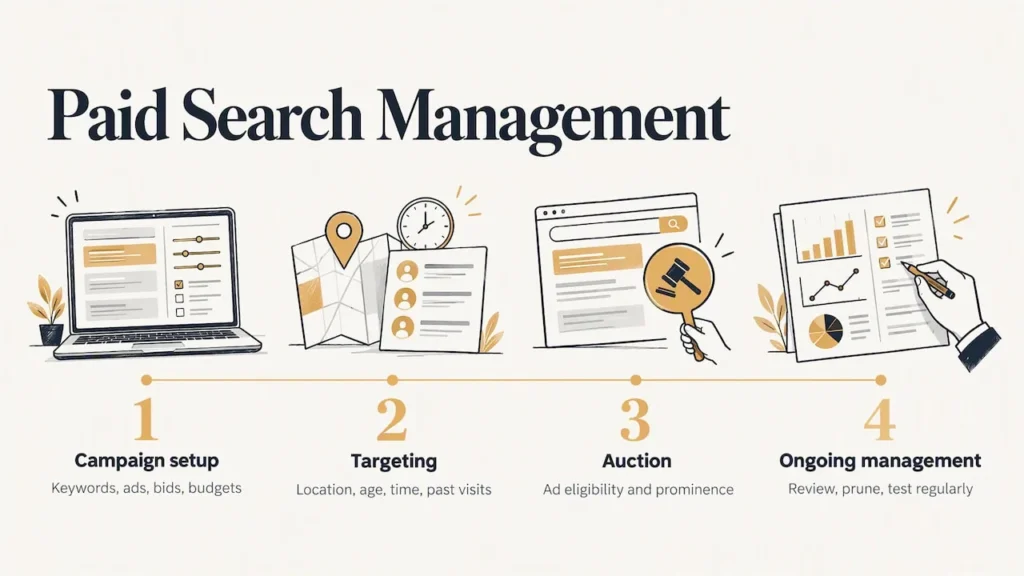
- Measurement. Deciding which actions count as conversions (a purchase, a form, a call), recording each one once, and feeding real sales or lead quality back in. Google says you need conversion tracking before you can use Smart Bidding at all.
- Account structure. Grouping keywords by intent so each ad group answers one need, with an ad and landing page to match.
- Targeting and settings. Locations, languages, audiences, schedules and devices. Google’s campaign settings control where ads appear, who sees them and how much you spend.
- Bidding and budgets. Choosing a bid strategy that suits your data volume, and protecting spend from waste. Search terms and negative keywords get reviewed often in the early months, then on a steady rhythm.
- Ads and assets. Writing and testing responsive search ads, and adding sitelinks, callouts and other assets.
- Reporting and decisions. A plain-English monthly report on what was spent, what it produced, what changed, and what happens next.
Why good management lowers what you pay per click
This is where the fee earns its money back. The highest bidder doesn’t automatically win. Google’s Ad Rank weighs your bid alongside the quality of your ad and landing page, Ad Rank thresholds, auction competitiveness, the context of the search and the expected impact of your assets. Google also says higher ad quality generally leads to better performance, including better positions and lower costs per click.
So two advertisers with the same budget can pay very different prices for the same position. A manager who tightens the match between search, ad and landing page is cutting your media bill, and that saving belongs in any sum of what the fee is worth. Our explainer on Quality Score in Google Ads covers the relevance side in detail.
What’s usually extra
These are often charged separately:
- A set-up or audit fee for a new or inherited account, especially if the tracking needs rebuilding.
- Landing page design and development.
- Video and image creative for Performance Max, YouTube or Display.
- Extra platforms such as Microsoft Ads, Meta or LinkedIn.
- CRM integration and offline conversion imports for lead generation.
That last one matters more than it looks, because a form fill is only a proxy for a customer. Google’s guidance on multi-source conversions describes adding conversions from a CRM or order system, ideally uploaded within 24 hours, so bidding learns which enquiries turned into money. An account without that link optimises for cheap forms, and cheap forms rarely pay the bills.

The landing page sits in the same category. If the page after the click is slow or confusing on a phone, better ads just send more people to a dead end. A clinic, for example, loses bookings when that page is unclear, and a purpose-built physiotherapy website design with booking integration makes it far easier to see which ads produce appointments. Ask whether landing page advice is in the fee, even if the build isn’t.
Is an agency cheaper than a freelancer or an in-house hire?
Not always, but an in-house hire is rarely the cheap option people expect. For accounts below a fairly high spend, an agency or freelancer usually costs less than a salaried specialist, and an agency gives you cover for holidays and a wider bench of skills.
In-house
ITJobsWatch, which tracks advertised UK roles, puts the median PPC manager salary at £45,000 and the median PPC executive salary at £32,000 for the six months to 2 November 2026. Both figures come from a small number of vacancies (around 20 each), so read them as a rough guide.
Then add employer costs. Employer National Insurance is 15% on earnings above £5,000 a year for 2026 to 2027. On a £45,000 salary that’s £6,000, taking the cost to about £4,250 a month before pension, recruitment and tools. And it buys one person’s view of your account, with nobody checking their work.
Freelancer
A good freelancer can be excellent value for a single account with modest spend and a straightforward offer, and you’ll usually deal with them directly. We haven’t found a reliable UK survey of freelance PPC rates, so compare day rates and monthly retainers on scope, not on headline price. The risks are continuity, because holidays and illness happen, and a narrower set of skills when the account needs creative or tracking work.
Agency
An agency makes most sense when you need several specialisms working together: search, Shopping, creative, tracking, web development and analytics. Watch for opaque reporting, long lock-ins and junior staff quietly running an account you were sold by a senior. Our piece on five reasons to hire a Google Ads agency sets out when the case is strongest.
Doing it yourself
DIY costs nothing but your time. The hidden cost is bad habits baked into the account, such as missing tracking and default settings left on. If you go it alone, use Google’s campaign setup checklist and pay for an audit once spend grows.
Why do quotes for the same account vary so much?
Quotes vary because providers are pricing different amounts of work. The things that push a fee up are mostly predictable:
- Number of campaigns and markets. One local search campaign is a small job. Five countries in three languages is not.
- Ecommerce feeds. Shopping and Performance Max depend on a clean Merchant Center feed. Google notes that Shopping campaigns need at least 15 conversions per Merchant Center ID in the last 30 days for Target ROAS, so smaller shops often need more hands-on bidding until the data builds.
- Lead quality work. CRM links, call tracking and offline imports take set-up time and regular checking.
- State of the account. Inheriting a tidy account is cheaper than untangling three years of broad match and duplicate conversions.
- Reporting and contact. A monthly email is cheaper than weekly calls and a live dashboard.
- Creative. Writing ad copy is standard. Producing video for YouTube or Performance Max usually isn’t.
If two quotes differ by a factor of three, check them against this list. One has usually left something out.
How do you know if the fee is good value?
Judge the fee by the total cost of each customer, not by the fee on its own. Add ad spend and management fee together, divide by the number of sales or qualified leads, and compare that with what a customer is worth to you. If that sum works, the fee is earning its place.
Start with what you can afford to pay
The North East Growth Hub tells businesses to know their margins and make sure the website converts before putting ad spend behind it. It also makes the point that Google Ads captures demand that already exists, so if few people search for what you sell, no fee will fix that.
A quick test with illustrative numbers. Your average order is £120 and your gross margin is 40%, so each sale makes £48 before advertising. That £48 is your break-even cost per sale. If 3 in every 100 visitors buy, you can afford about £1.44 a click (£48 × 3%) before you lose money, and that’s before any management fee.

Then put the fee into the sum
Now compare two illustrative quotes for a lead generation business where a new customer is worth £3,000 in profit.
- Quote A: £400 a month. The account produces 10 customers from £2,600 of ad spend. Total cost £3,000, or £300 a customer.
- Quote B: £1,200 a month. Better tracking and lead filtering mean the same £2,600 of spend produces 16 customers. Total cost £3,800, or £237.50 a customer.
The second agency costs three times as much in fees and is still the cheaper way to buy customers. The cheaper quote only wins if the dearer one can’t deliver that extra quality, which is what references and case studies are for. (These figures are made up to show the maths.)
For a real example of the fee showing up in efficiency rather than volume, our Nicholas Charles Fragrances case study, published in July 2024, reported Google Ads campaigns running at a 6.13:1 average ROAS since we started, and month-to-date sales up 82% year on year while traffic and spending were down 63%.
Read the report, not just the invoice
A useful monthly report answers four questions: what did we spend and what did it produce, what changed, what did we learn, and what happens next. Google’s shop reporting shows conversions, conversion value, CPA and ROAS, and notes that uploaded conversions can take up to seven days to appear, so the latest days often look worse than they are.
Be wary of reports that lead with impressions and click-through rate. They’re easy to improve and say little about your business. Our guide to the key success metrics for PPC covers which numbers deserve your attention.
Plenty of UK businesses aren’t sure they’re getting value. In LOCALiQ’s UK research, 36% of businesses said they were satisfied with their paid search performance and 25% said they weren’t, with the rest not running it. If you’re in that 25%, the fix is usually measurement before money.
What should a Google Ads management quote include?
A good quote shows the fee and the ad budget as separate numbers and spells out the scope, the people, the term and who owns the account. If any of those are missing, ask before you sign.
- The fee, the media budget and any set-up cost, each shown separately.
- What’s included each month: search term reviews, ad testing, landing page advice, reporting and calls.
- Who actually works on the account, and how many other accounts they look after.
- Minimum term and notice period. Long tie-ins protect the agency, not you.
- Account ownership. The Google Ads account should be in your name, with the agency given access. You’re entitled to your customer ID under Google’s third-party policy.
- How results are reported, and against which business outcomes.
- What’s excluded, such as creative, landing page builds or extra platforms.
If an agency shows a Google Partner badge, Google’s advertiser guide suggests clicking it to check the profile behind it. And if a quote is built around a “guaranteed” number of leads or sales, walk away. Our list of red flags when hiring a marketing agency covers the other warning signs.
Where we stand on fees
We’ve worked in search marketing since 2014, and the most expensive accounts we inherit rarely had the highest fee. They’re the ones run in isolation, optimised for their own dashboard, with no line back to real enquiries.
So our advice on cost is simple. Pay for measurement first, insist on seeing the fee and the media spend separately, and judge every provider, including us, on cost per customer. If you’re based in the North West and want someone in the room, we also work as a PPC agency in Liverpool from our office at Mann Island.
FAQs
Is the management fee included in my Google Ads budget?
No. Your ad budget is what Google charges for clicks. The management fee is paid to the person or agency running the account. Google’s third-party policy requires agencies to disclose a separate fee and to report Google’s charges without it, so ask for both figures in writing.
How much should a small business pay for Google Ads management?
Agency-published UK ranges start at roughly £300 to £800 a month for small accounts, or 10 to 20% of ad spend, with no independent survey behind them. On a very small budget, the fee can rival the spend itself, so a well-run DIY account or a freelancer may be better value until spend grows.
Is a percentage-of-spend fee a bad deal?
Not necessarily. It’s simple and scales down when you cut budget. The risk is that the agency earns more when you spend more, whether or not results improve. If you accept it, agree targets for cost per sale or lead in writing, and check for minimum fees.
How much does paid search management cost compared with Google Ads management?
Paid search management covers search ads on Google and other engines such as Microsoft Bing, so PPC management cost follows the same pricing models. Adding Microsoft Ads or another platform usually adds to the fee, because each one needs its own set-up, tracking checks and optimisation time.
Do agencies charge a set-up fee?
Many do, especially when an account needs an audit, a rebuild or new conversion tracking. A set-up fee is reasonable if it buys defined work. Ask what it covers, and whether the account and everything built in it stay with you if you leave.
Sources
- UK Google Ads and PPC statistics 2026, Whito
- How much should PPC management cost?, Search Engine Journal (April 2025)
- Google third-party policy, Google Ads Help
- Advertiser guide: working with third parties, Google Ads Help
- Using Google Ads for online marketing, Google Ads Help
- About ad quality, Google Ads Help
- Set up your campaign for success, Google Ads Help
- About campaign settings, Google Ads Help
- Multi-source conversions, Google Ads Help
- Target ROAS for Shopping campaigns, Google Ads Help
- View your shop sales conversions, Google Ads Help
- Search advertising benchmarks 2026, LocaliQ
- UK digital marketing statistics, LOCALiQ UK
- PPC manager salaries, ITJobsWatch
- PPC executive salaries, ITJobsWatch
- Rates and thresholds for employers 2026 to 2027, GOV.UK
- Using paid social and Google Ads to increase revenue, North East Growth Hub


